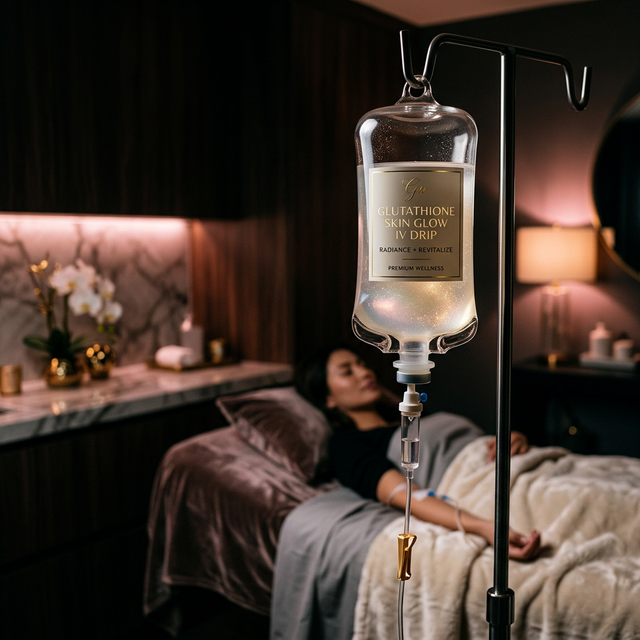
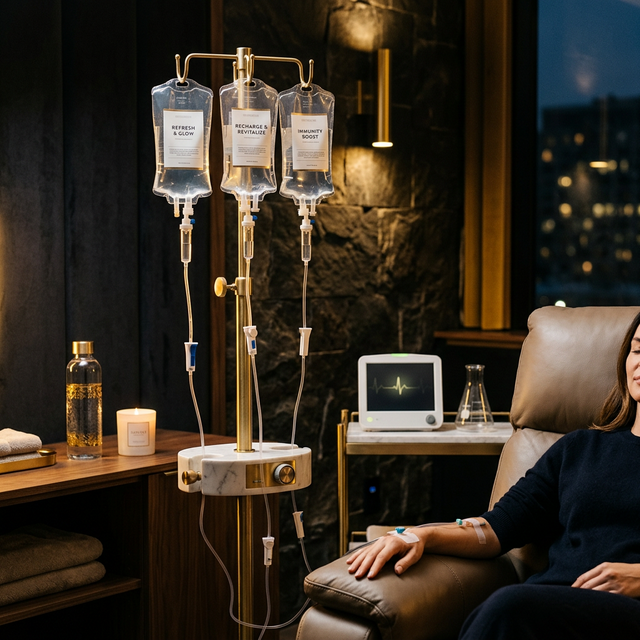
Beauty IV drips have become one of the most photographed treatments in modern wellness culture. The aesthetic of a glamorous infusion — sometimes with a yellow or golden-tinted bag, administered in a spa-like setting — has been embraced by influencers and celebrities alike. But underneath the Instagram aesthetic is a genuine biochemical question: do these infusions actually improve skin quality, hair health, and appearance?
The honest answer is: some ingredients have a real scientific case. Others are included primarily for marketing rather than evidence. And the gap between what's claimed in clinic marketing and what's demonstrated in clinical research is significant.
This guide covers what beauty IV drips actually contain, what the evidence supports, what's overstated, and how to set realistic expectations before investing in treatment.
Disclaimer: This article is for educational purposes only. Beauty IV drips are not FDA-approved for cosmetic purposes. Consult a licensed healthcare provider before pursuing any IV treatment.
What Are Beauty IV Drips?
Beauty IV drips — marketed under names like "Glow Drip," "Radiance Infusion," "Collagen Drip," or "Skin Brightening IV" — are intravenous infusion formulations targeting skin quality, hair and nail health, and aesthetic vitality.
They differ from standard immunity drips primarily in their ingredient emphasis:
Standard immunity drip focus: Immune cell support, antioxidant protection, vitamin and mineral repletion for immune function
Beauty drip focus: Melanin modulation (skin tone), collagen synthesis support, hair and nail keratinocyte health, anti-aging antioxidant protection specifically for dermal tissue
The overlap is substantial — many ingredients serve both purposes. The differences are primarily in the relative emphasis and specific additions (glutathione for skin lightening, biotin for hair and nails, higher ALA for anti-aging antioxidant effects).
Common Beauty IV Drip Ingredients
Glutathione — The Skin Brightening Ingredient
Typical IV dose: 600-2,400 mg per session
Glutathione is the most pharmacologically interesting beauty drip ingredient and the primary active agent in skin lightening formulations.
The mechanism — tyrosinase inhibition: Glutathione inhibits tyrosinase, the rate-limiting enzyme in melanin synthesis. It shifts the melanin production pathway from eumelanin (darker, brown-black pigment) toward pheomelanin (lighter, reddish-yellow pigment). This is the biochemical basis for glutathione's skin-lightening effects.
Evidence:
- A 2012 open-label trial (Handog et al.) in 30 Filipino participants showed measurable melanin index reduction with oral glutathione 500 mg/day over 4 weeks
- A 2014 double-blind RCT (Watanabe et al., Clinical, Cosmetic and Investigational Dermatology) in 60 subjects confirmed oral glutathione produced significant melanin reduction over 12 weeks
The IV vs. oral gap: The evidence above is for oral glutathione. IV-specific RCTs for skin lightening are sparse. The short plasma half-life of IV glutathione (~2-3 minutes) raises legitimate questions about whether IV is superior to optimized oral delivery for this skin-specific application.
Widespread clinical use of IV glutathione for skin lightening is practiced in Asia — particularly the Philippines, Thailand, and South Korea — but the Philippine FDA has issued advisories noting the absence of an approved cosmetic indication and unproven long-term safety at cosmetic doses.
Honest expectation: Glutathione does have a real mechanism for skin brightening. Observable effects typically require multiple sessions (4-8+) and tend to reverse when treatment is stopped. Not a permanent skin change.
Vitamin C — Collagen and Melanin
Typical IV dose in beauty drips: 5,000-25,000 mg (5-25g)
Vitamin C has two key roles in skin biology:
1. Collagen synthesis cofactor: Vitamin C is an essential cofactor for prolyl hydroxylase and lysyl hydroxylase — the enzymes that perform the hydroxylation of proline and lysine residues in procollagen chains. Without adequate vitamin C, procollagen cannot be properly cross-linked into stable triple-helix collagen. This is established biochemistry, not marketing.
2. Melanin inhibition: Like glutathione, vitamin C inhibits tyrosinase — contributing to skin brightening and even-toning effects through a separate mechanism from glutathione. This creates a synergistic skin brightening effect when both are combined.
Evidence:
- Pharmacokinetic evidence (Levine et al., NIH): IV achieves 100x higher plasma concentrations than oral — relevant for saturating collagen synthesis enzymes
- Topical vitamin C RCTs show improved skin texture and collagen content (Nusgens et al., 2001; multiple subsequent studies)
- IV-specific cosmetic RCTs are limited; benefits extrapolated from topical and pharmacokinetic data
Realistic expectation: Collagen synthesis is a weeks-to-months process. IV vitamin C supports this process — it doesn't produce visible collagen improvements after a single session.
Alpha-Lipoic Acid (ALA) — Anti-Aging Antioxidant
Typical IV dose: 300-600 mg per session
ALA is unique among antioxidants for its dual water- and fat-solubility — it acts in both cytoplasm and cell membranes. It also:
- Regenerates glutathione, vitamin C, and vitamin E — amplifying the antioxidant network
- Inhibits formation of advanced glycation end-products (AGEs) — AGE accumulation in dermal collagen is a key driver of skin stiffness, loss of elasticity, and reduced radiance
- Crosses the blood-brain barrier (relevant for cognitive effects, less so for purely cosmetic applications)
Evidence: Strong for oral ALA in diabetic neuropathy (ALADIN trials, Ziegler et al., NATHAN-1 trial). Anti-AGE effects suggest plausible anti-aging dermal benefits. IV-specific cosmetic evidence is absent — benefits extrapolated from oral neuropathy research and mechanistic reasoning.
Biotin — Hair and Nails
Typical IV dose: 5,000-10,000 mcg (5-10 mg)
Biotin is the ingredient most heavily marketed for hair and nail improvement in beauty drips. The honest evidence:
When biotin works: In people with documented biotin deficiency, biotinidase deficiency, or specific metabolic conditions — biotin supplementation reliably improves hair loss, brittle nails, and skin symptoms.
When biotin doesn't help: A systematic review by Patel et al. (2017, Skin Appendage Disorders) analyzed 18 cases and studies and concluded: all documented improvements with biotin occurred in individuals with underlying deficiency. No evidence supports biotin improving hair or nail quality in people who are not deficient.
A safety concern with high-dose biotin: The FDA issued a safety communication in 2017 noting that high-dose biotin (including from supplements and IV) can interfere with cardiac troponin immunoassays — causing false-low results in heart attack diagnostic tests. If you have high-dose biotin and develop chest pain, alert emergency providers that you have received biotin supplementation.
Realistic expectation: Biotin in a beauty drip is likely effective for the subset of people who are genuinely biotin-deficient (a small minority of healthy adults). For most people, the expected hair and nail benefit is minimal.
B-Complex Vitamins
Roles in skin:
- B3 (Niacinamide): Evidence-supported topical application for hyperpigmentation, skin barrier function, and fine lines; IV delivery for skin-specific benefit is extrapolated
- B5 (Pantothenic acid): Supports wound healing and keratinocyte health
- B7 (Biotin): Discussed above
- B12: DNA methylation, cell division; deficiency causes oral and skin changes
Zinc
Dose: 5-15 mg elemental zinc IV
Zinc is a cofactor for matrix metalloproteinases (MMPs) that regulate collagen turnover and tissue remodeling. It also supports wound healing, has anti-inflammatory properties, and contributes to antioxidant enzyme function (superoxide dismutase). Its role in skin health is genuine — particularly for individuals with deficiency, which is common.
Ingredients of Questionable Benefit in Beauty Drips
IV Collagen Peptides: Some clinics include hydrolyzed collagen in IV formulations. This is scientifically problematic — IV collagen peptides are rapidly degraded and eliminated by the body within hours. Their molecular weight makes targeted tissue delivery implausible. Oral collagen peptides (5-10g/day) have substantially better evidence for skin hydration and elasticity improvement. IV collagen is a marketing choice, not a scientifically rational one.
IV Hyaluronic Acid: IV-administered HA is degraded within hours by hyaluronidases. The premise that systemically circulating HA fragments meaningfully reach and hydrate the dermis through IV delivery is not established by clinical evidence. HA injected intra-dermally (fillers) or applied topically is well-supported. IV HA is not.
The Evidence: What Beauty Drips Actually Do
| Claimed Effect | Evidence Level | Most Credible Mechanism |
|---|---|---|
| Skin brightening / lighter tone | Moderate (oral); Limited (IV-specific) | Tyrosinase inhibition (glutathione + vitamin C) |
| Improved collagen and skin texture | Mechanistically strong; clinical evidence limited | Vitamin C as collagen synthesis cofactor |
| Reduced hyperpigmentation | Moderate | Tyrosinase inhibition |
| Improved hair and nail health | Limited (deficiency-specific) | Biotin, zinc correction of deficiency |
| Anti-aging / reduced fine lines | Preliminary | ALA, vitamin C antioxidant + collagen support |
| "Immediate glow" after session | Primarily anecdotal | Hydration, placebo, transient intravascular volume |
| Collagen rebuilding within hours | Not supported | Collagen synthesis takes weeks-months |
The Honest Conversation About Results
Many people feel genuinely better after beauty IV drips — refreshed, more energetic, with skin that seems to have more clarity or brightness. It's important to parse this experience carefully:
What's real:
- Genuine deficiency correction (if you were subclinically deficient in vitamin C, zinc, or B vitamins) can produce visible skin improvements over a course of sessions
- Glutathione does have real melanin-modulating effects — visible over multiple sessions, not hours
- The combination of pharmacological vitamin C + glutathione creates a synergistic skin-brightening effect with a sound mechanistic basis
What's likely placebo or transient:
- "Immediate glow" seen right after infusion (could be intravascular volume effect, improved circulation from IV fluid, or placebo response)
- Claims of "overnight transformation" of skin
- Single-session dramatic results
What requires months of treatment:
- Meaningful collagen density changes
- Sustained, progressive skin brightening
- Hair quality improvement (hair growth cycle is 3-6 months)
How Much Do Beauty IV Drips Cost?
| Formulation | Approximate US Cost |
|---|---|
| Glutathione Glow (basic) | $150-$300 |
| Full Beauty Drip (glutathione + vitamin C 15g + ALA + biotin) | $250-$450 |
| Premium Beauty Protocol (25g vitamin C + high-dose glutathione) | $350-$600 |
| Initial consultation | $100-$300 additional |
| Session package (6-10 sessions) | 10-15% discount |
Who Are Beauty IV Drips Most Appropriate For?
Best-suited candidates:
- People with documented deficiencies (vitamin C, zinc, B vitamins) affecting skin quality
- Those with hyperpigmentation concerns who want to explore glutathione-based brightening
- People seeking supportive therapy alongside dermatological treatments for overall skin health
- Individuals wanting an evidence-informed approach to skin anti-aging nutrition
Less appropriate:
- Anyone expecting single-session dramatic results
- People expecting IV to replicate or outperform evidence-based topical skincare (retinoids, topical vitamin C, SPF)
- Anyone with G6PD deficiency (contraindicated for high-dose vitamin C; relative contraindication for glutathione at very high doses)
The Bottom Line
Beauty IV drips contain ingredients with genuine mechanisms relevant to skin health — particularly glutathione, vitamin C, and alpha-lipoic acid. The evidence for clinical benefit in skin quality, brightening, and anti-aging is mechanistically sound but limited by a small number of IV-specific controlled trials.
The most honest summary: beauty drips can be a biologically rational component of a comprehensive skin health strategy — but they are not a substitute for consistent topical skincare, sun protection, adequate nutrition, and sleep. The best results come from combining evidence-based skincare habits with periodic IV sessions for nutritional support.
For skin brightening specifically, multiple sessions over 4-8+ weeks are needed to observe meaningful melanin changes — not a single dramatic session.
Related reading:
- Glutathione IV Drip for Skin: Benefits, Evidence, and Safety
- IV Drips vs. Oral Supplements: What the Evidence Shows
- Immunity IV Drip Benefits: What the Science Actually Supports
- IV Therapy and Advanced Wellness Treatments: The Complete Guide
This article is for educational purposes only. Beauty IV drips are not FDA-approved for cosmetic purposes. Consult a licensed healthcare provider before starting any IV treatment.