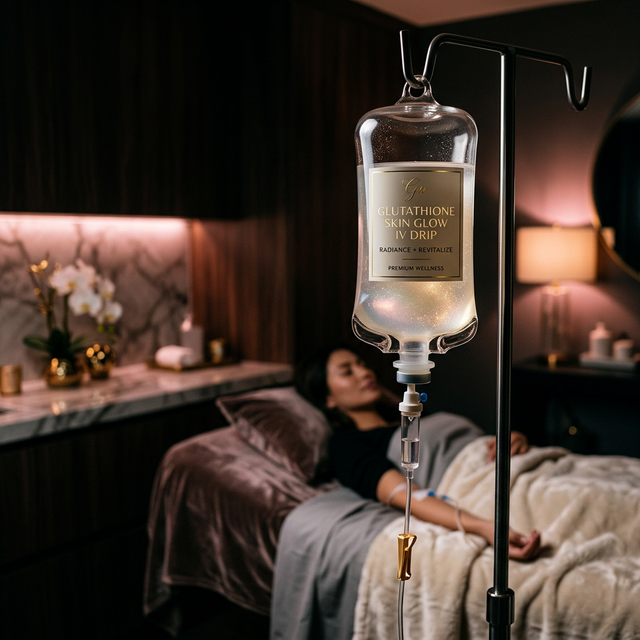
Of all the ingredients in the beauty IV drip space, glutathione generates the most interest — and the most controversy. It's the most commonly requested skin-focused IV infusion globally, with a particular following in Southeast Asia, East Asia, and increasingly in the United States, UK, and Middle East.
The claims are bold: brighter skin, reduced hyperpigmentation, a more luminous complexion, and over time, a noticeably lighter overall skin tone. The biochemical mechanism behind these effects is real. But the clinical evidence specifically for intravenous glutathione is less robust than the marketing suggests — and the safety picture has some important nuances worth understanding before you book a session.
This guide gives you the complete, honest picture.
Disclaimer: This article is for educational purposes only. IV glutathione is not FDA-approved for skin lightening or any cosmetic purpose. Consult a licensed healthcare provider before pursuing any IV treatment.
What Is Glutathione and Why Does It Matter for Skin?
Glutathione (GSH) is a tripeptide — a small protein made from three amino acids: glycine, cysteine, and glutamate. It is produced naturally by every cell in the body and is the most abundant and important endogenous antioxidant in human biology.
It performs several critical functions:
- Master antioxidant: Scavenges reactive oxygen species (ROS), recycles vitamins C and E, and maintains the cellular redox balance
- Hepatic detoxification: Central to Phase II detoxification reactions in the liver — conjugates toxins for excretion
- Immune cell protection: Prevents oxidative damage to lymphocytes and neutrophils during immune responses
- Melanin modulation: This is the mechanism most relevant to skin — glutathione influences the pathway cells use to produce pigment
The Melanin Mechanism: How Glutathione Brightens Skin
Human skin gets its color from melanin, produced by specialized cells called melanocytes. There are two types of melanin:
- Eumelanin: Brown-black pigment; predominates in darker skin tones and UV-exposed skin
- Pheomelanin: Red-yellow pigment; lighter; predominates in fairer skin tones
Both types are produced by the same cellular machinery — starting with the amino acid tyrosine — but the pathway diverges based on which chemical is available to react with the tyrosinase intermediate.
Glutathione's role: At adequate intracellular concentrations, glutathione reacts with the intermediate DOPA-quinone (produced by tyrosinase acting on tyrosine), shunting the pathway toward pheomelanin production rather than eumelanin. Simultaneously, glutathione inhibits tyrosinase itself — the rate-limiting enzyme in all melanin synthesis — reducing total pigment output.
The net biochemical result: higher glutathione levels → less eumelanin → lighter, more even skin tone.
This is real biochemistry, supported by cell culture studies and the established mechanism of glutathione in melanocyte biology. It is not a fabricated marketing claim.
What Does the Clinical Evidence Say?
Here the picture becomes more nuanced — because most of the rigorous evidence is for oral glutathione, not intravenous.
Evidence for Oral Glutathione (Stronger)
Handog et al. (2012), International Journal of Dermatology:
- Open-label single-arm trial; n=30 Filipino participants
- Oral glutathione 500 mg/day for 4 weeks
- Result: Statistically significant reduction in melanin index (measured by Mexameter device) on both sun-exposed and non-sun-exposed skin
- Limitation: No placebo control; small sample; open-label design
Watanabe et al. (2014), Clinical, Cosmetic and Investigational Dermatology:
- Double-blind, placebo-controlled RCT; n=60 Japanese participants
- Oral oxidized glutathione 250 mg/day for 12 weeks
- Result: Significant reduction in melanin index and improved skin condition scores vs. placebo
- Evidence quality: Moderate — best-designed study for glutathione skin lightening
Sonthalia et al. (2016), Indian Dermatology Online Journal (Review):
- Comprehensive narrative review concluded: evidence for glutathione as a skin lightener is biologically plausible and supported by preliminary clinical data; long-term safety of high-dose IV glutathione specifically is not established; regulatory agencies in several countries have issued safety advisories
Evidence for IV Glutathione (Weaker)
Dedicated, peer-reviewed, placebo-controlled RCTs specifically evaluating IV glutathione for skin brightening in humans are sparse as of early 2026. The widespread clinical practice of IV glutathione for skin in Asia — involving millions of sessions annually — significantly outpaces the formal trial evidence base.
What exists for IV:
- A 2014 pilot study found IV glutathione improved NK cell activity in HIV patients — immune endpoint, not skin
- Multiple case series and anecdotal clinical reports from Philippine, Thai, and Korean clinics; not controlled
- Mechanistic extrapolation from the oral evidence and in vitro data
The critical pharmacokinetic challenge for IV glutathione: IV glutathione has a plasma half-life of approximately 2-3 minutes — it is rapidly taken up by hepatocytes and other cells or cleaved by gamma-glutamyl transferase (GGT) in the plasma. This extremely short circulating half-life raises a legitimate scientific question: does IV glutathione actually deliver meaningfully more GSH to melanocytes in skin tissue than well-optimized oral supplementation?
The liver is the primary beneficiary of IV glutathione delivery — it makes sense for hepatic antioxidant support. For peripheral skin tissue, the picture is less clear. Some argue that the hepatic GSH increase from IV treatment subsequently redistributes to peripheral tissues; others argue that oral precursors (N-acetylcysteine, which provides cysteine for intracellular GSH synthesis) may be more effective for skin-specific outcomes.
This is an honest area of scientific uncertainty — not a settled question.
How Many IV Glutathione Sessions Do You Need?
Glutathione IV therapy for skin is never a one-session treatment. Based on clinical practice patterns:
Observable brightening effect: Most practitioners and patients report first noticing visible skin tone changes after 6-10 sessions. Some patients see earlier changes; some take longer.
Typical initial course: 8-12 weekly sessions (2-3 months) to establish meaningful melanin reduction
Maintenance: Monthly sessions to sustain results — effects are reported to diminish when treatment is stopped, as melanin synthesis resumes at pre-treatment rates without ongoing tyrosinase inhibition
Dose range:
- Skin brightening: 600-1,200 mg per session (moderate)
- Skin whitening protocols: 1,200-2,400 mg per session (higher doses)
Sessions are often combined with:
- Vitamin C (5-25g IV): Enhances glutathione's skin brightening via separate tyrosinase inhibition; also supports glutathione recycling by converting oxidized GSSG back to active GSH
- Alpha-lipoic acid (300-600 mg): Regenerates glutathione and vitamin C; anti-AGE effects for skin aging
Glutathione IV for Skin: Who Is It Most Appropriate For?
Potentially Well-Suited
- Adults seeking to reduce hyperpigmentation (melasma, sun spots, post-inflammatory hyperpigmentation from acne or eczema)
- Those wanting to achieve a more even, uniform skin tone
- People with oxidative stress-driven skin concerns (dull complexion, uneven texture related to environmental exposure)
- Individuals who have tried oral glutathione with partial response and want higher-intensity treatment
Not the Right Primary Approach For
- Anyone expecting a single session to produce visible results
- People with unrealistic expectations about the permanence of skin lightening (effects reverse when treatment stops)
- Individuals with G6PD deficiency (see safety section)
- Anyone with active liver disease (IV glutathione is metabolized hepatically — increased burden on a compromised liver)
How Does IV Glutathione Compare to Oral Glutathione for Skin?
| Factor | IV Glutathione | Oral Glutathione |
|---|---|---|
| Bioavailability | 100% (immediate) | Previously thought negligible; Richie et al. 2015 showed meaningful blood GSH elevation at 1,000 mg/day |
| Plasma half-life | 2-3 minutes | Varies; slower, sustained absorption |
| Reach to skin melanocytes | Uncertain — very short plasma circulation | Possibly comparable via hepatic redistribution and direct gut wall absorption |
| Clinical skin evidence | Limited IV-specific RCTs | Moderate — Handog 2012, Watanabe 2014 |
| Cost per month | $600-$2,400+ | $50-$150 |
| Convenience | Clinic visit | Daily capsule |
The evidence comparison is humbling for IV proponents: the published RCT evidence for skin lightening uses oral glutathione, not IV. The IV route is assumed superior based on bioavailability theory — but skin-specific IV vs. oral RCTs have not confirmed this assumption.
For skin lightening specifically, a rational approach is:
- Well-optimized oral glutathione (1,000 mg/day, with oral vitamin C and ALA for recycling support)
- IV glutathione sessions for more intensive periodic delivery — combined with IV vitamin C
Safety of Glutathione IV for Skin
General Safety Profile
At wellness doses (600-1,200 mg per session), IV glutathione is generally well-tolerated. Reported adverse effects:
- Mild nausea or dizziness (uncommon)
- Temporary skin hypersensitivity (rare)
- Redness or discomfort at IV site
Regulatory Alerts
Philippine FDA (2011, updated 2020): Issued multiple advisories warning against IV glutathione for skin whitening, citing:
- No approved cosmetic indication
- Unproven safety at cosmetic doses in long-term use
- Reports of adverse outcomes from uncontrolled clinic administration
This advisory applies specifically to unregulated use in poorly supervised settings — not to medically supervised administration at appropriate doses — but it reflects legitimate regulatory concern about widespread unsupervised practice.
G6PD Deficiency: At very high doses, particularly when combined with high-dose IV vitamin C (which generates H₂O₂), there is a theoretical risk of hemolysis in G6PD-deficient patients. G6PD testing before high-dose combination protocols is advisable.
Long-Term Safety: An Unanswered Question
High-dose, long-term IV glutathione for purely cosmetic purposes lacks long-term safety data (beyond 12 months of regular use). In medically supervised settings at standard doses, no significant safety signals have emerged from clinical practice — but the absence of evidence is not evidence of absence, particularly for multi-year use.
The Thyroid Concern
Some case reports from Asia describe thyroid function changes in patients receiving chronic high-dose IV glutathione. The mechanism is unclear and not definitively established, but periodic thyroid function monitoring in patients on long-term skin lightening protocols is reasonable.
Realistic Results: What to Actually Expect
What you can reasonably expect after a proper course:
- Progressive, gradual brightening of skin tone — typically 1-2 shades lighter in Fitzpatrick scale terms with sustained treatment
- Reduction in focal hyperpigmentation (melasma, sun spots) — often the most notable and appreciated effect
- More even skin tone and improved luminosity — widely reported subjectively
- Effects typically begin to be noticeable after session 6-10
What to understand about permanence:
- Results are not permanent — glutathione does not destroy melanocytes; it modulates their pigment output
- When treatment stops, melanocyte activity normalizes and melanin production resumes
- Sun exposure accelerates pigment return — diligent SPF use is essential during and after treatment
- Maintenance sessions (monthly or bimonthly) are needed to sustain results
The "immediate glow" after a session:
Many patients notice a subtle skin luminosity change immediately or within 24 hours of an IV glutathione session. This is likely attributable to the antioxidant effect reducing oxidative stress in dermal tissue (acute effect) rather than melanin reduction (which takes weeks). It's real and pleasant — but represents a different mechanism than the sustained brightening from melanin modulation.
Cost of Glutathione IV for Skin
| Protocol | Cost Per Session | Recommended Initial Course | Estimated Total Initial Investment |
|---|---|---|---|
| Moderate brightening (600-900 mg + vitamin C 10g) | $150-$280 | 8-10 sessions | $1,200-$2,800 |
| Intensive whitening (1,200-2,400 mg + vitamin C 25g + ALA) | $250-$450 | 10-12 sessions | $2,500-$5,400 |
| Maintenance (monthly post-course) | $150-$450/session | Ongoing | $1,800-$5,400/year |
For a full cost context: How Much Does IV Therapy Cost?
The Bottom Line
Glutathione IV therapy for skin has a real, established biochemical mechanism — tyrosinase inhibition and pheomelanin-pathway shunting — and clinical evidence for skin brightening, primarily from oral studies. The intravenous route is widely practiced and generally safe under clinical supervision, but IV-specific controlled trials for skin outcomes are limited, and the claimed superiority of IV over well-optimized oral delivery for peripheral skin tissue has not been conclusively demonstrated.
If you're considering glutathione IV for skin:
- Set realistic expectations — gradual improvement over multiple sessions, not single-session transformation
- Understand results are maintained only with continued treatment
- Ensure your provider screens for G6PD status, especially for high-dose protocols
- Consider whether a trial of high-dose oral glutathione (with vitamin C and ALA) might be a reasonable, evidence-consistent, and significantly more affordable first step
Related reading:
- Beauty IV Drips: Ingredients, Real Benefits & Honest Expectations
- IV Drips vs. Oral Supplements: What the Evidence Shows
- IV Therapy Safety: Risks, Contraindications, and What to Ask
- IV Therapy and Advanced Wellness Treatments: The Complete Guide
This article is for educational purposes only. IV glutathione is not FDA-approved for cosmetic purposes. Always consult a licensed healthcare provider before pursuing any IV treatment.