If you've been researching ozone therapy, you've probably encountered the term "major autohemotherapy" — often abbreviated as MAH. It is the foundational, most widely practiced, and most thoroughly researched form of systemic ozone therapy in the world. Before EBOO came along, MAH was simply "ozone therapy" in most clinical contexts.
This guide explains what major autohemotherapy is, how the procedure works step by step, what medical conditions it's been studied for, and what you can realistically expect from a course of treatment.
Disclaimer: This article is for educational purposes only. Major autohemotherapy is not FDA-approved in the United States. Consult a licensed healthcare provider before pursuing any ozone-based treatment.
What Is Major Autohemotherapy?
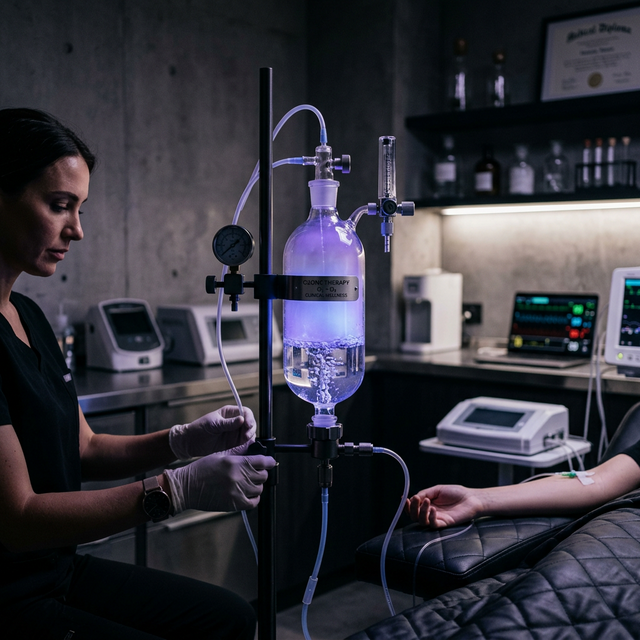
Major autohemotherapy (MAH) is a systemic ozone therapy method in which a portion of a patient's own blood is drawn, mixed with a calibrated ozone-oxygen gas mixture outside the body, and then re-infused intravenously. The term breaks down as:
- Major: Refers to the relatively larger blood volume involved compared to Minor Autohemotherapy (which uses 5-10 mL and is re-injected intramuscularly)
- Auto: The patient's own blood is used — no donor blood, no foreign substances other than the ozone-oxygen mixture
- Hemo: Blood
- Therapy: Treatment
The procedure has been practiced in Germany since the 1950s and has a robust international clinical literature — particularly from Germany, Italy, Spain, Cuba, and Russia. It is the primary reference point for most systemic ozone therapy research.
How Major Autohemotherapy Works: Step by Step
Pre-Treatment Requirements
Before your first MAH session, a responsible provider will require:
- G6PD enzyme assay — mandatory. G6PD (glucose-6-phosphate dehydrogenase) deficiency is an absolute contraindication.
- Complete blood count (CBC) — to screen for anemia and thrombocytopenia
- Comprehensive metabolic panel — liver and kidney function
- Coagulation profile (PT/INR, aPTT) — bleeding risk assessment
- Thyroid function tests (TSH, T4) — uncontrolled hyperthyroidism is a contraindication
- Blood pressure measurement
- Medication and supplement review — anticoagulants and high-dose antioxidants require special consideration
If a provider skips this workup, that is a serious red flag.
The MAH Procedure
Step 1: IV Access A needle is placed in an arm vein — typically the antecubital vein. The line is connected to a sterile collection system.
Step 2: Blood Collection 100-250 mL of blood (most commonly 150-200 mL) is drawn into a sterile, UV-resistant glass bottle or bag that contains a small amount of anticoagulant — typically sodium citrate or heparin to prevent clotting during the procedure.
Step 3: Ozone-Oxygen Introduction A precisely calibrated volume of ozone-oxygen gas is introduced into the collection bottle through a medical ozone generator. The concentration is typically 20-50 mcg/mL; the gas volume is 100-200 mL.
- The ozone generator produces ozone from pharmaceutical-grade oxygen at the exact concentration specified for the session
- Concentration is adjusted by the practitioner based on the patient's clinical picture, tolerance, and treatment goals
Step 4: Gentle Mixing The bottle is gently rotated or tilted to ensure thorough mixing of ozone-oxygen with the blood. This is done slowly and carefully — aggressive mixing is not required and not beneficial.
Step 5: Re-Infusion The ozonated blood is re-infused through the same IV line by gravity or gentle pressure. The return infusion is slow and controlled.
Total session time: 30-60 minutes
What You Experience During MAH
Most patients report little sensation during a well-administered MAH session:
- Mild awareness of warmth as the ozonated blood returns
- Occasional mild lightheadedness (typically brief)
- Some patients notice a subtle metallic taste
You remain seated or reclined comfortably throughout. A clinician or nurse is present.
What to Expect After MAH
Post-treatment responses vary:
Common (first few sessions):
- 24-48 hours of mild fatigue or flu-like symptoms — this is the Herxheimer-like reaction, described in ozone therapy literature as a temporary inflammatory response to cellular repair processes
- Some patients feel immediately energized; others need a recovery day
After a full course:
- Most practitioners note that effects build across sessions — the first 3-4 treatments establish the pattern, with improvements becoming more apparent by sessions 5-10
- Patients with chronic conditions typically report gradual, cumulative improvement
MAH Dosing and Protocols
Standard MAH Parameters
| Parameter | Typical Range |
|---|---|
| Blood volume withdrawn | 100-250 mL (commonly 150-200 mL) |
| Ozone concentration | 20-50 mcg/mL (most common: 30-40 mcg/mL) |
| Gas volume | 100-200 mL O3/O2 |
| Total ozone dose | 3,000-8,000 mcg (3-8 mg) per session |
| Session duration | 30-60 minutes |
| Anticoagulant | Sodium citrate (preferred) or heparin |
Ozone Concentration Guide
| Concentration Range | Clinical Use |
|---|---|
| < 10 mcg/mL | Sub-therapeutic systemically; mucosal applications only |
| 10-30 mcg/mL | Anti-inflammatory emphasis; gentler protocols |
| 30-50 mcg/mL | Standard MAH range; antimicrobial + antioxidant activation |
| 50-80 mcg/mL | Higher range; severe infections / immune stimulation |
| > 80 mcg/mL | Supratherapeutic — NOT recommended for systemic use |
Treatment Frequency by Indication
| Indication | Frequency | Typical Total Sessions |
|---|---|---|
| Chronic fatigue / immune support | 2x/week for 3-5 weeks, then 1x/week maintenance | 10-20 initially |
| Chronic hepatitis | 3x/week for 4-6 weeks | 15-20 |
| Peripheral arterial disease | 3x/week for 4-6 weeks | 15-20 |
| Autoimmune (adjunctive) | 1-2x/week for 4-8 weeks | 8-16 |
| Wellness / longevity | 1-2x/week for 4 weeks, monthly maintenance | 8-10 initially |
What Conditions Is MAH Used For?
Applications With the Strongest Supporting Evidence
Peripheral Arterial Disease (PAD) Multiple European and Cuban clinical studies demonstrate improved walking distance, enhanced wound healing, and better quality of life. The vascular mechanisms — improved RBC deformability, nitric oxide promotion, reduced blood viscosity — align directly with PAD's pathophysiology.
Chronic Hepatitis B/C (Adjunctive) Cuban CENIC research shows improved liver enzyme profiles and viral load markers with MAH. These studies are largely observational, but the findings are consistent across a substantial patient population.
Immune Modulation MAH is widely used for chronic infections, recurrent illness, and immune dysregulation. NK cell activity increases, interferon production rises, and chronic inflammatory markers improve with treatment courses.
Applications With Emerging Evidence
Chronic Fatigue Syndrome / ME/CFS Small pilot studies and observational reports show subjective improvement in energy, cognitive function, and quality of life. No large controlled trials have been completed, but the mechanistic basis (improved cellular oxygenation, mitochondrial stimulation) is sound.
Long COVID Support Italian case series report improvements in post-COVID fatigue, dyspnea, and cognitive fog with ozone therapy. Larger trials are ongoing. MAH is being evaluated as an adjunctive treatment for Long COVID's multi-system inflammatory profile.
General Wellness and Longevity Many health-optimizing individuals use periodic MAH as part of a comprehensive wellness protocol, typically 1-2 sessions monthly after completing an initial course.
MAH vs. Minor Autohemotherapy: What's the Difference?
| Feature | Major Autohemotherapy | Minor Autohemotherapy |
|---|---|---|
| Blood volume | 100-250 mL | 5-10 mL |
| Route of return | Intravenous (IV) | Intramuscular (IM injection) |
| Systemic effect | More pronounced | More localized immune stimulation |
| Session time | 30-60 minutes | 10-15 minutes |
| Use case | Systemic conditions, chronic disease | Immune stimulation, adjunctive |
| Cost | $150-$350 | $75-$150 |
Minor autohemotherapy is often used as an introduction to ozone therapy, or as an adjunct alongside MAH for specific immune-stimulating goals.
Is MAH Safe?
MAH has one of the best-documented safety records of any alternative/complementary therapy:
The Jacobs 1982 German Safety Survey: 384,775 ozone treatments analyzed. Complication rate: ~0.0007% (7 per million sessions). Zero fatalities from correctly administered autohemotherapy.
This safety record compares favorably with conventional procedures and medications that carry far higher complication rates.
The key conditions for that safety record:
- Mandatory G6PD testing and screening
- Use of certified medical-grade ozone generators
- Correct technique — no direct IV gas injection
- Trained, licensed practitioners
- Proper ozone concentration calibration (never exceeding safe ranges)
When MAH is not safe: When performed by untrained practitioners, without proper screening, using uncalibrated equipment, or using the obsolete and dangerous direct IV gas injection method. These scenarios have caused the serious adverse events documented in the literature.
How Much Does MAH Cost?
In the United States, major autohemotherapy sessions typically cost $150-$350 per session. This makes it significantly more accessible than EBOO therapy ($400-$800) while sharing many of the same core mechanisms.
A standard initial course of 10 sessions costs $1,500-$3,500 before any package discounts. Monthly maintenance (1-2 sessions) runs $150-$700 per month.
Finding a Qualified MAH Provider
Look for:
- Medical director with MD, DO, or ND credentials
- Practitioner affiliation with the American Academy of Ozonotherapy (AAO) or equivalent international body
- Mandatory G6PD testing requirement (non-negotiable)
- Use of certified medical-grade ozone generators
- A clinician present throughout the session, not just for setup
- Compounded medications from an accredited pharmacy
The Bottom Line
Major autohemotherapy is the most established, most studied, and most accessible form of systemic ozone therapy. Its mechanisms are well-characterized, its safety record is excellent in properly screened patients administered by qualified practitioners, and it has moderate-to-strong clinical evidence for several specific applications.
It is not a cure-all, and the evidence for some wellness applications (anti-aging, general performance) is thinner than for its established clinical uses. But for people exploring ozone therapy for the first time, MAH represents the natural starting point — and for many patients, it remains the right ongoing treatment without needing to escalate to EBOO.
Related reading:
- What Is Ozone Therapy? How It Works and What to Expect
- Ozone Therapy Benefits and Risks: The Evidence-Based Review
- EBOO vs. Ozone Therapy: Which Is Right for You?
- IV Therapy and Advanced Wellness Treatments: The Complete Guide
This article is for educational purposes only. Major autohemotherapy is not FDA-approved. Always consult a licensed healthcare provider before pursuing any ozone therapy.