If you're exploring ozone-based treatments, you've probably encountered both "ozone therapy" and "EBOO therapy" — sometimes used almost interchangeably, sometimes presented as entirely different things. The reality is somewhere in between: EBOO is a form of ozone therapy, but a meaningfully different one in terms of technique, intensity, and cost.
This comparison guide explains both treatments from the ground up, highlights the critical differences, reviews the evidence for each, and helps you think through which approach makes more sense for your situation.
Disclaimer: This article is for educational purposes only. Neither EBOO nor ozone therapy is FDA-approved for wellness or medical indications. Always consult a licensed healthcare provider.
First: What Both Treatments Have in Common
EBOO therapy and standard ozone therapy share the same core mechanism:
Medical-grade ozone (O3), at precisely controlled concentrations, is introduced to blood. At therapeutic doses, ozone reacts with plasma lipids to generate secondary messenger molecules that activate the body's own antioxidant and healing systems. This is the hormesis principle — a mild oxidative stimulus that triggers a proportionally larger protective response.
Both treatments aim to:
- Upregulate antioxidant enzymes (via Nrf2 pathway)
- Improve red blood cell oxygen-delivery capacity
- Modulate immune function
- Reduce chronic oxidative stress and inflammation
They differ significantly in how they deliver ozone to blood and how much blood they treat per session.
What Is Standard Ozone Therapy (Major Autohemotherapy)?
Major Autohemotherapy (MAH) is the gold-standard systemic ozone treatment, practiced since the 1950s in Germany and now offered globally. It is the most clinically researched method of systemic ozone delivery.
The MAH procedure:
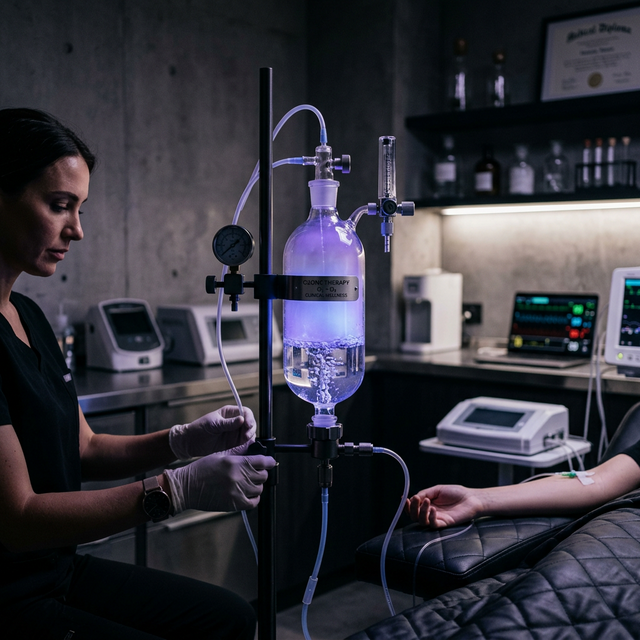
- A practitioner draws 100-200 mL of blood from an arm vein into a sterile, heparinized glass or plastic bag
- A calibrated volume of ozone-oxygen gas (at 20-50 mcg/mL) is introduced into the bag
- The bag is gently agitated so ozone contacts the blood
- The ozonated blood is re-infused through the same IV line
- Total process: 30-60 minutes
How much blood is treated: 100-200 mL — roughly 1-4% of total blood volume.
MAH has been studied in well-designed trials and systematic reviews across multiple applications:
- Knee osteoarthritis (multiple RCTs, meta-analysis confirming pain reduction)
- Peripheral arterial disease (European and Cuban clinical series)
- Chronic hepatitis B/C (adjunctive support)
- Chronic fatigue and fibromyalgia (small controlled trials)
- Wound healing adjunct
What Is EBOO Therapy?
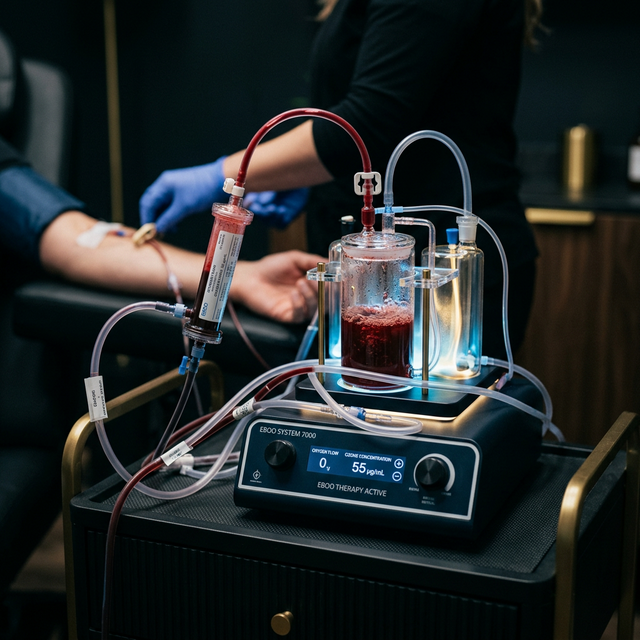
EBOO (Extracorporeal Blood Oxygenation and Ozonation) uses an external circuit — similar in concept to dialysis equipment — to treat a much larger volume of blood per session.
The EBOO procedure:
- Two IV access points are established (withdrawal and return)
- Blood flows through the external circuit via a peristaltic pump
- Blood passes across a semi-permeable hollow-fiber membrane
- Ozone-oxygen gas contacts the blood across the membrane
- Ozonated blood returns to the patient continuously
- Total session: 60-90 minutes
How much blood is treated: 2,000-3,000 mL per session — roughly 40-60% of total blood volume.
EBOO is a newer modality with limited dedicated clinical trials. Most evidence supporting its use is extrapolated from the broader MAH ozone literature combined with its theoretical advantages.
Head-to-Head Comparison: EBOO vs. Ozone Therapy (MAH)
| Feature | MAH (Standard Ozone) | EBOO Therapy |
|---|---|---|
| Blood volume treated per session | 100-200 mL (1-4% of total) | 2,000-3,000 mL (40-60% of total) |
| Method | Batch process in bag | Continuous circuit with hollow-fiber membrane |
| Filtration | None | Semi-permeable membrane |
| Session duration | 30-60 minutes | 60-90 minutes |
| IV access required | 1 line (single arm) | 2 lines (both arms typically) |
| Clinical evidence | Moderate — decades of research | Preliminary — extrapolated from MAH |
| Cost per session (US) | $150-$350 | $400-$800 |
| Sessions typically needed | 8-20 for therapeutic courses | 6-12 |
| Availability | Widespread | Limited to specialized clinics |
| Complexity | Lower | Higher |
| Regulatory history | Longer record | Newer entrant |
Where the Evidence Is Stronger: Ozone Therapy (MAH)
For all the theoretical advantages of EBOO, MAH has the stronger evidence base — simply because it's been studied far longer.
Notable MAH evidence highlights:
- A 2018 meta-analysis of 8 RCTs (n=485) in knee osteoarthritis found intra-articular ozone significantly superior to placebo for pain reduction at 4 and 12 weeks
- Multiple European RCTs for herniated disc and radiculopathy showed meaningful pain reduction and improved function, with some patients avoiding surgery
- Cuban clinical series (CENIC) demonstrate improved walking distance, wound healing, and quality of life in peripheral arterial disease patients with MAH
- A 1982 German safety survey (Jacobs) covering 384,775 ozone treatments reported a complication rate of ~0.0007% — 7 per million sessions
MAH also has the benefit of a recognized international guideline document: the ISCO3 Madrid Declaration on Ozone Therapy, which establishes standardized protocols and training requirements.
Where EBOO Has the Theoretical Advantage
Despite its thinner evidence base, EBOO's design advantages are real and scientifically meaningful:
1. Higher blood volume throughput If the therapeutic mechanism of ozone works by triggering antioxidant pathways throughout the blood, treating 40-60% of blood volume instead of 1-4% could produce proportionally larger effects. This is biologically logical even if unconfirmed in direct comparison trials.
2. Continuous treatment dynamic MAH is a batch process — blood is drawn, ozonated as a static volume, and returned. EBOO is continuous — blood is flowing and being ozonated constantly throughout the session, which may produce more uniform exposure.
3. Membrane filtration The hollow-fiber membrane in EBOO introduces a filtration component that MAH lacks. Proponents suggest this may remove inflammatory mediators, oxidized lipids, or other blood-borne compounds. The clinical significance of this filtration is unestablished but represents a potential mechanistic advantage.
4. For complex or severe cases Some practitioners use EBOO specifically for patients who have completed MAH courses with good initial response but are seeking more intensive or sustained treatment.
Which Ozone Therapy Is Right for You?
The answer depends on several factors:
Choose Standard MAH Ozone Therapy if:
- You are new to ozone therapy and want to assess your response at lower cost and risk
- You have a well-researched condition (knee OA, peripheral arterial disease, chronic fatigue) where MAH has documented evidence
- Budget is a primary consideration — MAH achieves the core mechanisms at 30-50% of EBOO's cost
- A qualified EBOO provider is not accessible in your area
- You prefer a treatment with a longer clinical history and published safety data
Consider EBOO if:
- You have tried standard MAH and had a positive response but want more intensive treatment
- You have a complex, multi-system chronic condition requiring a more comprehensive approach
- You have access to a highly qualified EBOO provider with clear protocols and appropriate equipment
- Your practitioner recommends it specifically based on your clinical picture and goals
- Cost is not a primary barrier and you understand the evidence limitations
When Neither May Be Appropriate:
- G6PD deficiency (absolute contraindication for all ozone therapies)
- Active pregnancy
- Severe bleeding disorders or thrombocytopenia
- Recent myocardial infarction
- Uncontrolled hyperthyroidism
A Practical Decision Framework
Here's a simple question sequence to guide your decision:
Step 1: Have I tried standard ozone therapy (MAH) before?
- No → Start with MAH to assess response at lower cost
- Yes → Did I respond well? → If yes, EBOO is worth considering
Step 2: What is my budget?
- Limited → MAH at $150-$350/session is more sustainable
- Flexible → EBOO is a viable option
Step 3: What condition am I addressing?
- Well-researched condition (OA, PAD, wound healing) → MAH has documented evidence
- Complex chronic condition, immune issues → EBOO may offer additional theoretical benefit
Step 4: Is a qualified EBOO provider accessible to me?
- Yes, with proper equipment and medical oversight → EBOO is feasible
- No qualified provider nearby → MAH is the appropriate option
Can You Combine Both?
Some practitioners use both modalities:
- Initial EBOO course for comprehensive treatment
- Maintenance with periodic MAH sessions (lower cost, sustainable long-term)
- Or alternating between EBOO and MAH based on clinical response
This combined approach makes biological sense — using EBOO's higher intensity for initial therapeutic loading, then MAH for ongoing maintenance. It also helps with cost management.
Questions to Ask Any Ozone Provider
Whether you're considering MAH or EBOO, ask prospective providers:
- Are you affiliated with the American Academy of Ozonotherapy (AAO) or another recognized body?
- Do you require G6PD testing before any ozone treatment? (Non-negotiable)
- What equipment do you use, and is it certified?
- How many treatments have you administered?
- What outcome data do you track?
- What is your protocol if I have an adverse reaction?
The Bottom Line
EBOO and standard ozone therapy (MAH) share the same fundamental mechanisms — the difference is primarily one of scale and delivery sophistication. MAH is the more established, better-researched, and more accessible option with a strong safety record and moderate clinical evidence. EBOO is the more intensive, higher-cost option with compelling theoretical advantages and a less developed evidence base.
For most people exploring ozone therapy for the first time, MAH is the rational starting point. EBOO represents a logical step up for those who have confirmed they respond to ozone and are seeking more intensive treatment — with a provider qualified to deliver it safely.
Related reading:
- What Is EBOO Therapy? A Complete Introduction
- EBOO Therapy Benefits: What the Research Actually Shows
- What Is Ozone Therapy? How It Works and What to Expect
- Ozone Therapy Benefits and Risks: The Evidence-Based Review
- IV Therapy and Advanced Wellness Treatments: The Complete Guide
This article is for educational purposes only. Neither EBOO nor ozone therapy is FDA-approved. Consult a licensed healthcare provider before starting any ozone-based treatment.