Interest in EBOO therapy has exploded in functional medicine and wellness circles over the past several years. Clinics describe it as the most comprehensive ozone treatment available, and patient testimonials range from increased energy and mental clarity to dramatic improvements in chronic conditions.
But what does the evidence actually support?
This article takes an honest, structured look at the claimed benefits of EBOO therapy — separating what is grounded in biology and clinical research from what is based on anecdote and extrapolation. If you're deciding whether EBOO is worth your time and money, this is the breakdown you need.
Disclaimer: This article is for educational purposes only. EBOO therapy is not FDA-approved for any indication. Speak with a licensed healthcare provider before pursuing any ozone or IV-based treatment.
How EBOO Is Supposed to Work (The Biological Foundation)
Before evaluating benefits, it's worth understanding the mechanisms EBOO operates through. All claimed benefits trace back to one key concept: therapeutic hormesis.
Ozone is toxic at high doses — but at precisely calibrated low doses, it triggers the body's own antioxidant and healing systems. This is the same principle behind certain exercise protocols (mild muscle damage triggers growth and repair) and certain dietary strategies (mild caloric restriction triggers longevity pathways).
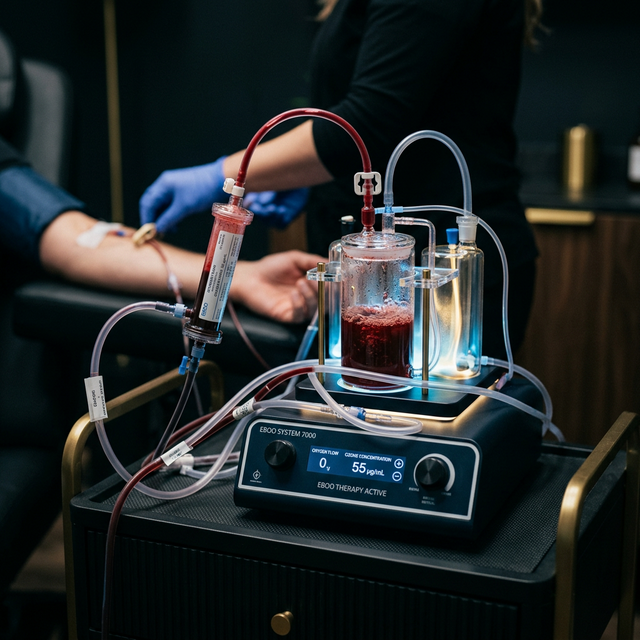
During an EBOO session, blood is ozonated across a hollow-fiber membrane. Ozone reacts with plasma lipids to generate:
- Lipid oxidation products (LOPs) — act as cellular signaling molecules
- Controlled hydrogen peroxide (H2O2) — crosses cell membranes to activate transcription factors
The primary downstream effects are:
- Nrf2 pathway activation → increased production of superoxide dismutase, catalase, and glutathione peroxidase
- Improved erythrocyte oxygen-release efficiency via 2,3-DPG synthesis
- Immune cell stimulation (NK cells, macrophages, interferon release)
- Nitric oxide synthesis promotion → vasodilation and improved microcirculation
These are well-characterized biochemical pathways. The question is how reliably EBOO treatment translates them into clinically meaningful outcomes.
The Evidence Landscape: An Honest Overview
Here is the key context before we explore individual benefits:
What the evidence base looks like:
- Strong, peer-reviewed RCT data exists for ozone therapy in orthopedics, wound care, and dentistry
- Moderate evidence exists for MAH (Major Autohemotherapy) in chronic fatigue, peripheral arterial disease, and chronic hepatitis
- EBOO-specific clinical trials are extremely limited as of early 2026 — most evidence is extrapolated from MAH research
- Patient-reported outcomes from EBOO clinics are consistently positive but are observational, uncontrolled, and subject to placebo effects and selection bias
This doesn't mean EBOO doesn't work — it means the clinical evidence hasn't caught up with its commercial deployment.
EBOO Therapy Benefit #1: Enhanced Cellular Oxygenation
Evidence Level: Mechanistically Established / Clinically Extrapolated
One of the most biologically grounded claims for EBOO is improved oxygen delivery to tissues. The mechanism: ozonation increases 2,3-DPG synthesis in red blood cells, shifting the oxygen-hemoglobin dissociation curve to the right. This means RBCs carry oxygen just as efficiently but release it more readily at the tissue level — exactly what hypoxic or poorly-perfused tissues need.
Additionally, ozone improves red blood cell deformability. Healthy RBCs are about 8 microns in diameter and must squeeze through capillaries as narrow as 5-6 microns. Aging, oxidative stress, and chronic disease stiffen RBCs and impair this ability. Ozonated blood shows improved deformability in laboratory analysis.
Who this matters most for: People with chronic fatigue, peripheral circulation issues, or conditions associated with tissue hypoxia.
Honest caveat: These effects are documented for ozone therapy generally (particularly MAH); EBOO-specific data on oxygen delivery changes in humans is lacking.
EBOO Therapy Benefit #2: Antioxidant System Upregulation
Evidence Level: Strong Mechanistically / Preliminary Clinically
This is arguably the most scientifically robust mechanism behind all ozone therapies. The controlled oxidative signal from therapeutic ozone activates the Nrf2/ARE transcription pathway, which upregulates endogenous antioxidant enzymes:
- Superoxide dismutase (SOD) — neutralizes superoxide radical
- Catalase — breaks down hydrogen peroxide
- Glutathione peroxidase (GPx) — reduces lipid peroxides
- Heme oxygenase-1 (HO-1) — anti-inflammatory, cytoprotective
The net result: the mild oxidative stimulus from ozone produces a compensatory antioxidant response that leaves your biological antioxidant capacity higher than before treatment. This is why ozone therapy, counterintuitively, has anti-inflammatory effects.
In human studies of Major Autohemotherapy, plasma antioxidant markers improve and oxidative stress markers decrease after treatment courses. Whether EBOO produces proportionally greater Nrf2 activation due to higher blood volume treatment is biologically plausible but unconfirmed in direct comparison studies.
EBOO Therapy Benefit #3: Immune System Modulation
Evidence Level: Moderate (from ozone therapy literature)
Medical ozone therapy has documented immune-modulatory effects across multiple study designs:
- Interferon stimulation: Ozone promotes release of interferon-gamma (IFN-gamma), an antiviral protein
- Interleukin-2 (IL-2) increase: IL-2 drives T-cell proliferation and immune activation
- NK cell enhancement: Natural killer cell cytotoxicity — the innate immune system's direct-attack capacity — is increased following ozone treatments
- Anti-inflammatory cytokine reduction: At therapeutic doses, ozone reduces TNF-alpha and IL-1beta, the primary drivers of chronic low-grade inflammation
This bidirectional immune action — stimulating acute immune responses while dampening chronic inflammation — is what makes ozone therapy potentially useful for both immune-compromised states (frequent infections, post-viral fatigue) and immune-overactivated states (chronic inflammatory conditions).
The EBOO advantage (theoretical): Processing 40-60% of total blood volume rather than 1-4% may deliver a proportionally larger immune stimulus per session.
EBOO Therapy Benefit #4: Antimicrobial Activity
Evidence Level: Strong In Vitro / Preliminary In Vivo
Medical ozone is one of the most potent antimicrobial agents known — in laboratory settings. Documented mechanisms include:
- Bacteria: Disrupts cell membrane integrity, oxidizes essential bacterial enzymes (sulfhydryl groups), effective against MRSA and antibiotic-resistant strains
- Viruses: Oxidizes viral capsid proteins, disrupts RNA and DNA replication machinery; in vitro efficacy shown against HIV, Hepatitis B and C, Herpes Simplex Virus, and SARS-CoV-2
- Fungi: Disrupts ergosterol in fungal cell walls; effective against Candida species
For ozone therapy administered systemically (including EBOO), the antimicrobial effects are indirect — ozone reacts with blood components, generating secondary oxidant species and activating the immune system, rather than directly contacting pathogens in tissues. This is an important distinction that complicates extrapolating in vitro antimicrobial data to in vivo systemic treatment.
Practical application: EBOO and ozone therapy are used adjunctively for chronic viral conditions (Lyme disease co-infections, Epstein-Barr reactivation, chronic hepatitis) in integrative medicine settings. Clinical outcomes are anecdotally positive but lack rigorous controlled trial validation.
EBOO Therapy Benefit #5: Cardiovascular and Vascular Support
Evidence Level: Moderate for MAH / Preliminary for EBOO
Ozone therapy's vascular effects are among its better-studied systemic benefits:
- Nitric oxide (NO) promotion: Ozone stimulates endothelial NO synthase, increasing NO production and causing vasodilation
- Prostacyclin (PGI2) stimulation: PGI2 is a natural vasodilator and inhibits platelet aggregation — reducing thrombosis risk
- Blood viscosity reduction: Improved RBC deformability reduces blood viscosity, easing flow through narrowed vessels
- Microcirculation improvement: Critical for peripheral arterial disease patients
Multiple European and Cuban clinical studies support Major Autohemotherapy for peripheral arterial disease (PAD) — showing improved walking distance, wound healing, and quality of life. These same mechanisms suggest potential benefit from EBOO, though direct EBOO trials in cardiovascular patients have not been published.
EBOO Therapy Benefit #6: Chronic Fatigue and Energy Support
Evidence Level: Emerging (observational data + mechanism)
Chronic fatigue is consistently the most commonly reported subjective improvement from EBOO and ozone therapy. The mechanistic basis is multifactorial:
- Improved cellular oxygenation (2,3-DPG effect on RBCs)
- Mitochondrial stimulation via low-concentration H2O2 activating the PGC-1alpha pathway, which drives mitochondrial biogenesis
- Reduction in the oxidative stress burden that chronically fatigued cells carry
- Immune normalization reducing the inflammatory "sickness behavior" associated with chronic low-grade infection
A subset of Long COVID patients has sought EBOO as adjunctive support, given the fatigue, cognitive impairment, and dysautonomia patterns that respond poorly to conventional management. Italian case series with systemic ozone therapy in post-COVID patients show promising but preliminary results. Large, controlled EBOO-specific trials for Long COVID have not yet been published.
EBOO Therapy Benefit #7: Detoxification Support
Evidence Level: Mechanistic / Anecdotal
The term "detoxification" in wellness marketing is frequently vague and scientifically imprecise. In the EBOO context, two legitimate mechanisms are worth discussing:
Filtration membrane effect: EBOO's hollow-fiber membrane is semi-permeable. Proponents suggest it may filter certain inflammatory mediators, oxidized lipids, and cellular debris from the blood — similar to how dialysis filters uremic toxins. This is biologically plausible but has not been formally tested in terms of what specifically is removed and whether removal is clinically meaningful.
Hepatic antioxidant support: The controlled oxidative stimulus from ozone activates hepatic Nrf2 pathways, upregulating glutathione synthesis and Phase II detoxification enzymes. This supports the liver's own detoxification capacity rather than directly "detoxing" the blood.
Honest assessment: "Blood detoxification" as a primary mechanism is overstated in marketing contexts. The filtration and hepatic support arguments have biological grounding but are not validated in clinical outcomes research.
Summary: What EBOO Benefits Are Best Supported?
| Claimed Benefit | Biological Mechanism | Evidence Strength |
|---|---|---|
| Improved cellular oxygenation | 2,3-DPG increase, RBC deformability | Strong mechanistically; limited EBOO-specific clinical data |
| Antioxidant enzyme upregulation | Nrf2/ARE pathway activation | Strong mechanistically; moderate from MAH trials |
| Immune modulation | NK cells, interferons, cytokine balance | Moderate from ozone therapy literature |
| Antimicrobial support | Indirect via immune activation | Strong in vitro; weak for systemic in vivo |
| Cardiovascular support | NO, PGI2, viscosity reduction | Moderate from MAH/PAD literature |
| Chronic fatigue improvement | Mitochondrial stimulation, oxygenation | Observational; mechanistically supported |
| Detoxification | Membrane filtration, hepatic Nrf2 | Theoretical/mechanistic |
Who Reports the Most Benefit from EBOO?
Across integrative medicine clinics offering EBOO, patients who most consistently report meaningful benefit include:
- Those with chronic fatigue syndromes — including ME/CFS and Long COVID
- People with chronic viral or bacterial infections — where immune modulation and indirect antimicrobial support is relevant
- Individuals with documented oxidative stress — those with high exposure to environmental toxins, metabolic syndrome, or chronic inflammation markers
- People who had positive responses to standard MAH ozone therapy and are seeking more intensive treatment
The patients who tend to report less dramatic benefit are healthy, well-nourished individuals with no specific chronic health challenges — a pattern consistent with diminishing returns from interventions that restore depleted systems.
The Bottom Line on EBOO Benefits
EBOO therapy has a compelling biological rationale and a meaningful body of supporting evidence — if you allow that most of that evidence comes from the broader ozone therapy literature rather than EBOO-specific trials.
The mechanisms are real. The extrapolation to EBOO from MAH data is scientifically reasonable. The patient-reported outcomes from clinical practice are consistently positive. But the definitive controlled trial evidence specifically validating EBOO's clinical benefit — in the way we would require for a pharmaceutical drug — does not yet exist.
If you're pursuing EBOO, do so with calibrated expectations, under the care of a qualified and licensed practitioner, and with full pre-treatment screening. View it as a biologically rational adjunctive therapy, not a proven cure for any specific condition.
Related reading:
- What Is EBOO Therapy? A Complete Introduction
- EBOO vs. Ozone Therapy: Which Is Right for You?
- Ozone Therapy Benefits and Risks: The Evidence-Based Review
- IV Therapy Safety Guide: What You Need to Know
This article is for educational purposes only and does not constitute medical advice. Consult a licensed healthcare provider before starting any treatment.