You've researched EBOO therapy, spoken with a provider, and decided to move forward with your first session. Now the practical questions take over: How should you prepare? What actually happens during the 60-90 minutes? What will you feel while the blood circulates through that external circuit? And what can you realistically expect in the days following treatment?
This guide answers all of those questions — practically and honestly — so you walk into your first EBOO session informed, prepared, and with calibrated expectations.
Disclaimer: This article is for educational purposes only. EBOO therapy is not FDA-approved for any medical indication. Always follow your provider's specific pre-treatment instructions, which take precedence over general guidance.
Before Your First EBOO Session: The Preparation Phase
Required Pre-Treatment Lab Work (Non-Negotiable)
EBOO therapy involves exposing your blood to medical-grade ozone. Before your first session, any responsible provider will require:
Mandatory:
- G6PD enzyme assay — the most critical pre-screening requirement. G6PD (glucose-6-phosphate dehydrogenase) deficiency is an absolute contraindication; without adequate G6PD, ozone's oxidative load can trigger acute hemolytic anemia. This test is non-negotiable — if your provider does not require it, find a different provider.
- Complete blood count (CBC) — screens for anemia (Hb < 7 g/dL is a contraindication), thrombocytopenia, and white cell abnormalities
- Comprehensive metabolic panel (CMP) — liver function (ozone requires adequate hepatic antioxidant processing) and kidney function
- Coagulation profile (PT/INR, aPTT) — bleeding risk assessment; anticoagulant therapy requires special consideration
- Blood pressure measurement — uncontrolled hypertension requires evaluation before treatment
Often also required:
- Thyroid function tests (TSH, T4) — uncontrolled hyperthyroidism is a contraindication
- Medication and supplement review — anticoagulants, immunosuppressants, and high-dose antioxidants require assessment
Timing: Most labs should be drawn 1-2 weeks before your first session so results are available for review before treatment day.
What to Do the Day Before
Day-before preparation:
- Hydrate well — drink 2-3 liters of water across the day. Well-hydrated veins are substantially easier to access, making IV placement smoother.
- Eat regular, nutritious meals — don't fast. Blood sugar should be stable before a session.
- Avoid alcohol for at least 24 hours — alcohol intoxication is a contraindication to ozone therapy, and even moderate drinking in the 24 hours prior can affect your physiological response.
- Avoid high-dose antioxidant supplements (vitamin C above 1g, vitamin E, glutathione) for 12-24 hours before — these can blunt the therapeutic oxidative signal from ozone. Your provider may give specific instructions on this.
- Get adequate sleep — fatigue doesn't preclude treatment but starting a 60-90 minute procedure well-rested is advisable.
What to Do the Morning Of
Day-of preparation:
- Eat a moderate meal 1-2 hours before your session — not heavy (you'll be reclined for an extended period), but enough to stabilize blood sugar
- Drink 500-750 mL of water in the 1-2 hours before arrival
- Wear comfortable, loose-fitting clothing — particularly clothing with easy access to both arms (a short-sleeved or easily rolled-up sleeveless top)
- Avoid caffeine immediately before if you tend toward anxiety or elevated heart rate, as the session can occasionally produce mild anxiety-like sensations in some people
- Bring something to occupy your time — book, podcast, downloaded content. You'll be stationary for 60-90 minutes.
- Arrange transportation if it's your first session — while most people feel fine to drive afterward, some experience mild fatigue or lightheadedness and it's prudent to have a backup plan.
Arriving at the Clinic: The Intake Process
On your first visit, allow extra time for intake — typically 20-30 minutes before your actual session begins.
What happens at intake:
- Review of your lab results and medical history by the supervising clinician
- Blood pressure check
- Review of current medications and supplements
- Explanation of the procedure, what to expect, and what to report to staff during the session
- Signed informed consent
This is your opportunity to ask any remaining questions. Good questions to ask:
- What ozone concentration will you use for my first session?
- What is the protocol if I feel unwell during the session?
- Is a nurse/clinician present throughout the entire session?
- What specific equipment are you using and is it certified?
The EBOO Procedure: Step by Step
IV Access Placement
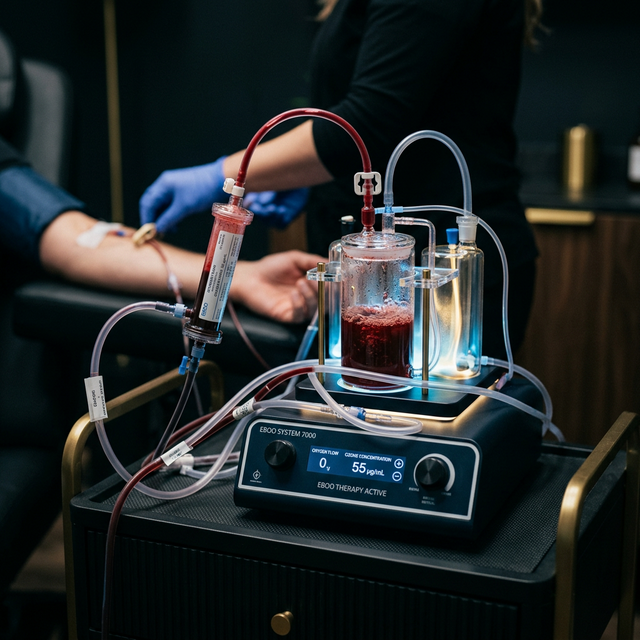
EBOO requires two separate IV access points — one for blood withdrawal and one for blood return. This is different from standard IV drips, which typically use one line.
Typical placement:
- Antecubital vein (inside of elbow) of one arm for blood withdrawal
- Antecubital or forearm vein of the other arm for blood return
The nurse will examine both arms and select the best access points. Two small needle sticks — one in each arm — and then only the soft plastic catheters remain in place, secured with medical tape. Once placed, you should not feel the catheters during the session unless the line position shifts.
If one arm has limited venous access: Your provider may use a larger-bore single-arm access or adjust the circuit configuration.
The Circuit Connection
Once both lines are in place, the EBOO circuit is connected:
- Blood withdrawal line → tubing → peristaltic pump → EBOO device → return tubing → return line
- The circuit is primed with sterile saline to remove air before your blood enters it
- The peristaltic pump is set at the appropriate flow rate for your body weight and clinical picture
Ozone Introduction
Inside the EBOO device, your blood passes across a semi-permeable hollow-fiber membrane. On the other side of the membrane, medical-grade ozone-oxygen gas is introduced at the calibrated therapeutic concentration — typically 30-50 mcg/mL for initial sessions. Your provider may start at the lower end of this range for a first session and titrate up in subsequent sessions based on your response.
The Active Infusion Period (60-90 Minutes)
Once the circuit is running:
- Blood flows continuously from one arm, through the EBOO circuit, and back through the other arm
- The process treats approximately 2,000-3,000 mL of blood over the course of the session
You will likely feel:
- Very little of anything initially — most patients are surprised by how uneventful the first 15-20 minutes feel
- A subtle warmth or mild tingling in the returning arm as ozonated blood re-enters your circulation — commonly reported and harmless
- Gradual relaxation — the enforced rest period has a calming effect for most people
- Possible mild awareness of increased alertness or energy as the session progresses — some patients notice this, others feel neutral
Some patients occasionally notice:
- Mild lightheadedness in the first few minutes (passes quickly; elevating the return arm or reclining further usually resolves it)
- Brief mild warmth or flushing (harmless; ozone's vasodilatory effect via nitric oxide)
- A subtle metallic taste (reported by a minority of patients)
- Mild anxiety or restlessness (uncommon; usually resolves within minutes)
Alert your nurse immediately if you experience:
- Chest pain or pressure
- Significant shortness of breath
- Marked dizziness or near-fainting
- Heart palpitations that feel uncomfortable
- Pain or unusual swelling at either IV site
Session Completion
When the treatment volume is complete:
- The pump stops; the circuit is disconnected
- Both IV catheters are removed
- Small bandages applied to both sites
- Your blood pressure may be checked
- You'll sit upright gradually before standing — don't rush this
Most sessions conclude smoothly. The clinical staff should be available for a brief post-session check-in.
After Your First EBOO Session: What to Expect
In the First Few Hours
Commonly reported:
- A sense of energy or alertness in the 2-6 hours post-session — particularly noticeable after first sessions in people who were significantly fatigued
- Some patients feel pleasantly calm and relaxed; others feel energized — responses vary considerably
- Mild arm soreness at both IV sites (normal; usually resolves in 24 hours)
Also possible (particularly after a first session):
- Mild fatigue in the evening — after the initial post-session energy, some people feel more tired than usual. This is reported as normal and typically related to the body's healing response.
- Mild headache (uncommon; stay well-hydrated post-session)
The 24-72 Hour Window: The Herxheimer-Like Reaction
This is the most important thing first-time EBOO patients should be prepared for: some patients experience a temporary "healing reaction" in the 24-72 hours after initial sessions.
What it involves:
- Mild flu-like symptoms — fatigue, achiness, low-grade fever
- Possible temporary worsening of existing symptoms before improvement
- Mild headache, nausea, or general malaise
This is described in ozone therapy literature as a Jarisch-Herxheimer-like reaction — analogous to the immune response that occurs during antibiotic treatment of certain bacterial infections when dying pathogens release inflammatory mediators. In the ozone context, it is theorized to relate to microbial die-off responses and cellular cleanup processes.
What to do:
- Rest, hydrate well, and eat lightly
- Avoid intense exercise in the 24 hours after your first session
- Do not interpret this as a treatment failure — practitioners generally view it as a sign of therapeutic response
- Contact your clinic if symptoms are severe or prolonged beyond 72 hours
The Days Following
After the initial response period (typically by days 3-5 after a first session):
- Many patients report improved energy baseline
- Improved sleep quality is commonly noted
- Some patients report clearer thinking and improved mood
- Improved physical performance in subsequent workouts
Important calibration: effects from a single EBOO session are typically modest. EBOO's benefits are described as cumulative — building across a series of sessions rather than dramatic after a single treatment.
How Many Sessions Will You Need?
For initial results assessment: Most practitioners recommend 2-3 sessions before evaluating whether treatment is producing meaningful benefit for you. Individual physiological responses vary; some patients notice significant improvement early while others require more sessions.
Typical therapeutic courses:
- General wellness / longevity: 6-8 sessions over 6-8 weeks; monthly maintenance
- Chronic condition support: 10-12 sessions over 10-12 weeks; bi-monthly to monthly maintenance
- EBOO after established MAH response: 4-6 sessions as intensive upgrade; monthly maintenance
Tracking your response: Consider keeping a simple symptom and energy journal across your EBOO course — noting energy levels, sleep quality, pain levels, cognitive clarity, and any other specific symptoms you're targeting. This helps you and your provider objectively evaluate response over time rather than relying on impression.
Questions to Ask After Your First Session
At your post-session check-in or follow-up call, discuss:
- Is my response typical for a first session?
- Should I adjust my supplement timing before subsequent sessions?
- What ozone concentration was used and will it change for future sessions?
- What should I watch for in the next 72 hours?
- How will we measure whether treatment is working for me?
The Bottom Line
Your first EBOO session will likely be quieter than you expect — 60-90 minutes in a reclining chair with two IV lines running a continuous blood circuit, managed by experienced clinical staff, with minimal discomfort in most cases. The dramatic visible transformation some clinics allude to doesn't happen in session one. What happens is the initiation of a biological process — antioxidant enzyme upregulation, immune modulation, improved RBC oxygen delivery — that builds across subsequent sessions.
Come prepared (hydrated, fed, clothed for easy access, and organized for your 60-90 minutes of enforced relaxation), stay communicative with your clinical staff during the session, and give the treatment a series of 4-6 sessions before drawing conclusions about your individual response.
Related reading:
- What Is EBOO Therapy? A Complete Introduction
- EBOO Therapy Benefits: What the Research Actually Says
- EBOO Therapy Cost: How Much Should You Expect to Pay?
- EBOO vs. Ozone Therapy: Which Is Right for You?
- IV Therapy Safety Guide
- IV Therapy and Advanced Wellness Treatments: The Complete Guide
This article is for educational purposes only. EBOO therapy is not FDA-approved for any medical indication. Always follow your licensed provider's specific pre-treatment and post-treatment instructions.