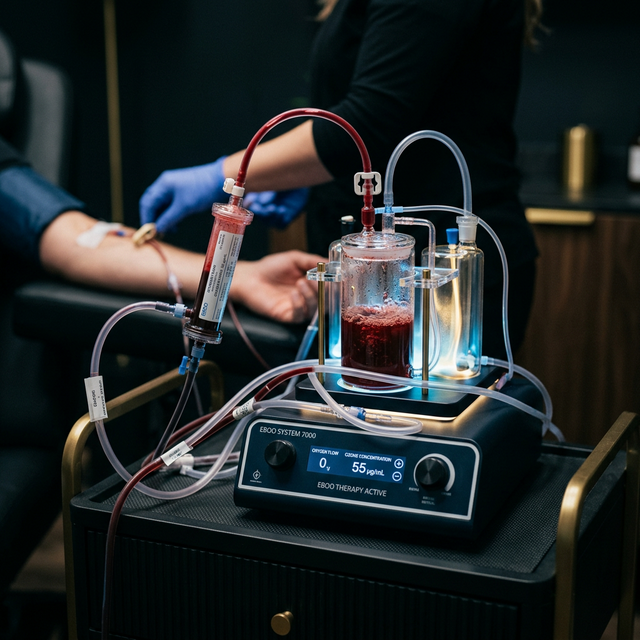
You may have seen EBOO therapy mentioned in longevity clinics, functional medicine offices, or biohacking forums. The term sounds medical and technical — because it is. But behind the acronym is a treatment concept that is simpler to understand than its name suggests: it cleans and energizes your blood using medical-grade ozone, outside the body, in a process similar to dialysis.
This guide breaks down exactly what EBOO therapy is, how a session works, what the science says about its effects, who it's designed for, and what honest expectations look like.
Disclaimer: This article is for informational purposes only. EBOO therapy is not FDA-approved for any medical condition. Consult a licensed healthcare provider before considering any IV or ozone-based treatment.
What Does EBOO Stand For?
EBOO stands for Extracorporeal Blood Oxygenation and Ozonation.
Let's break that down word by word:
- Extracorporeal: Outside the body — blood is removed, treated externally, and returned
- Blood: Your actual blood is what's being processed
- Oxygenation: The blood is enriched with pure oxygen (O2)
- Ozonation: The blood is exposed to medical-grade ozone (O3) — a reactive form of oxygen
Taken together, EBOO is a procedure where blood is drawn from your body, passed through an external filtration circuit where it is treated with ozone and oxygen, and then returned to your bloodstream. Think of it as an advanced, high-throughput version of the ozone therapy methods that have been used in European clinical medicine for decades.
How Is EBOO Different From Regular Ozone Therapy?
To understand EBOO, it helps to know the most common form of ozone therapy it evolved from: Major Autohemotherapy (MAH).
In standard MAH, a practitioner draws 100-200 mL of blood into a sterile bag, mixes it with ozone-oxygen gas, and re-infuses it intravenously. The whole process takes 30-60 minutes. MAH has been practiced since the 1950s in Germany and has a substantial body of clinical research behind it.
EBOO takes this concept significantly further:
| Feature | Major Autohemotherapy (MAH) | EBOO Therapy |
|---|---|---|
| Blood volume processed | 100-200 mL per session | 2,000-3,000 mL per session |
| Method | Batch (bag) ozonation | Continuous circuit with hollow-fiber membrane |
| Filtration | None | Semi-permeable membrane filtration |
| Session time | 30-60 minutes | 60-90 minutes |
| Ozone contact | Brief, static | Continuous, dynamic |
| Relative cost | $150-$350 | $400-$800 |
The critical difference: EBOO processes roughly 40-60% of your total blood volume in a single session, compared to MAH's 1-4%. This is why proponents describe EBOO as a far more comprehensive ozone delivery method.
How Does an EBOO Session Work?
Here is a step-by-step walkthrough of a typical EBOO session:
Before Your Session
Most reputable EBOO providers require pre-treatment lab work including:
- G6PD enzyme assay (mandatory — G6PD deficiency is an absolute contraindication)
- Complete blood count (CBC)
- Comprehensive metabolic panel (liver and kidney function)
- Coagulation panel
- Blood pressure measurement
During the Session (60-90 Minutes)
IV access is established: Two access points are needed — one for blood withdrawal and one for return. This is typically two separate arm veins or a larger-bore cannula depending on the setup.
The circuit is connected: Blood is drawn through tubing to the EBOO device, powered by a peristaltic pump that moves blood smoothly through the circuit.
Blood meets the filtration membrane: Inside the device, blood passes through a semi-permeable hollow-fiber membrane. Ozone-oxygen gas (typically at concentrations of 30-50 mcg/mL) is introduced on the other side of the membrane.
Ozonation occurs: The ozone reacts with the blood components across the membrane — treating red blood cells, plasma lipids, and white blood cells with the controlled oxidative stimulus that triggers the therapy's biological effects.
Treated blood returns: Ozonated blood flows back through the return line and into your bloodstream continuously.
You rest comfortably: Most patients lie in a reclining chair during treatment. Some clinics play calming music or offer eye masks. You may feel a subtle warming sensation as the treatment progresses.
After the Session
Most patients notice no immediate dramatic effects during the session itself. Post-session experiences vary widely:
- Some people feel energized within hours
- Others feel temporarily fatigued for 24-48 hours (a "healing reaction" reported by ozone practitioners)
- A small number experience mild flu-like symptoms after initial sessions — sometimes called a Herxheimer-like reaction, theoretically related to microbial die-off responses
What Happens Biologically During EBOO?
The biological effects of EBOO center on ozone's unique property: it is simultaneously a toxic oxidant at high doses and a therapeutic stimulus at precisely controlled low doses. This is the principle of hormesis.
When ozone contacts blood plasma, several key biochemical events unfold:
1. Nrf2 Pathway Activation
Ozone reacts with polyunsaturated fatty acids in the blood, generating lipid oxidation products and controlled hydrogen peroxide (H2O2). These act as cellular messengers that activate the Nrf2 transcription factor. Nrf2 then upregulates the body's own antioxidant enzymes:
- Superoxide dismutase (SOD)
- Catalase
- Glutathione peroxidase (GPx)
- Heme oxygenase-1 (HO-1)
The result is a net antioxidant effect that exceeds the initial oxidative stimulus — meaning a controlled pro-oxidant treatment actually leaves the body more antioxidant-protected than before.
2. Improved Oxygen Delivery
Ozonation increases the synthesis of 2,3-DPG (2,3-diphosphoglycerate) in red blood cells, shifting the oxygen-hemoglobin dissociation curve. In practical terms: your red blood cells release oxygen more readily to tissues after EBOO treatment. Ozone also improves red blood cell deformability — they can squeeze through narrowed capillaries more easily, improving oxygen delivery to ischemic or poorly-perfused tissues.
3. Immune System Modulation
EBOO stimulates the release of:
- Interferons (antiviral immune proteins)
- Interleukin-2 (IL-2) — promotes T-cell proliferation
- NK cell activation — natural killer cells are part of the innate immune response to infections and abnormal cells
Simultaneously, at therapeutic doses, ozone may reduce chronic inflammatory cytokines like TNF-alpha and IL-1beta — making it potentially modulatory rather than simply stimulatory.
4. Antimicrobial Effects
Medical ozone is a potent antimicrobial agent:
- Oxidizes bacterial cell membranes and sulfhydryl groups on bacterial enzymes
- Disrupts viral capsid proteins and replication machinery
- Effective in vitro against MRSA, Hepatitis B/C, HSV, and SARS-CoV-2
5. Vascular Benefits
Ozone promotes endothelial nitric oxide (NO) release, causing vasodilation and improved blood flow. It also stimulates prostacyclin (PGI2), a natural vasodilator and platelet aggregation inhibitor.
What Is EBOO Therapy Claimed to Treat?
Proponents of EBOO therapy claim benefits for a wide range of conditions and wellness goals. Here is an honest assessment of evidence levels:
Conditions With Some Supporting Evidence (from ozone therapy literature broadly):
- Chronic fatigue and low energy
- Chronic infections (viral, bacterial, fungal)
- Immune dysregulation and autoimmune support
- Peripheral circulation problems
- Inflammatory conditions
Wellness Goals (Theoretical/Anecdotal):
- Anti-aging and longevity optimization
- "Blood detoxification"
- Athletic performance and recovery
- Post-COVID / Long COVID support
Important note: The clinical evidence cited above comes primarily from Major Autohemotherapy (MAH) research — not from EBOO-specific controlled trials. EBOO is a newer modality that has entered commercial practice ahead of its own dedicated research base. Results from MAH studies are extrapolated to EBOO based on shared mechanisms and the theoretical advantage of higher blood volume treatment.
Who Should Consider EBOO Therapy?
EBOO may be a reasonable consideration for:
- Adults with chronic fatigue not responding to conventional approaches
- Those with documented chronic infections or immune challenges
- People seeking adjunctive support for cardiovascular or circulatory concerns
- Biohackers and longevity-focused individuals interested in antioxidant pathway optimization
- Individuals who have tried and responded well to standard ozone therapy (MAH)
EBOO is not appropriate for:
- Anyone with G6PD deficiency
- Pregnant women
- Individuals with active bleeding disorders or severe thrombocytopenia
- Those with uncontrolled hyperthyroidism or severe anemia
- Recent myocardial infarction (within 6 months)
- Anyone taking anticoagulants without specialist review
What Are the Risks of EBOO?
EBOO is generally considered safe in properly screened patients at certified facilities. Reported adverse effects include:
- Temporary fatigue or flu-like symptoms after initial sessions (Herxheimer-like reaction)
- Mild lightheadedness during treatment
- Soreness at venipuncture sites
- Rarely: bruising or phlebitis at IV sites
Serious risks (rare, associated with improper technique or inadequate screening):
- Air embolism (prevented by properly maintained closed circuits)
- Hemolysis at supratherapeutic ozone concentrations (prevented by proper dosing)
- G6PD crisis in unscreened patients (absolutely preventable with mandatory testing)
The German safety record for autohemotherapy is often cited: a landmark 1982 survey by Jacobs covering 384,775 ozone treatments found a complication rate of approximately 0.0007% — 7 per million sessions. EBOO, as a newer and more intensive modality, does not yet have equivalent large-scale safety data.
How Much Does EBOO Therapy Cost?
In the United States, EBOO sessions typically cost between $400 and $800 per session. Most providers recommend a starting series of 4-10 sessions, making an initial course investment of $1,600-$8,000 before any package discounts.
Insurance does not cover EBOO therapy. It is classified as elective/experimental across all U.S. payers.
International comparison:
- Germany/Austria: €300-€600 per session
- Mexico (medical tourism): $200-$400 USD
- UAE/Gulf Region: $400-$700
For a detailed cost breakdown and what affects EBOO pricing, see: EBOO Therapy Cost: How Much Should You Expect to Pay?
Key Questions to Ask a Potential EBOO Provider
Before booking an EBOO session, ask:
- Do you require G6PD testing before treatment? (Non-negotiable. If the answer is no, find a different provider.)
- What equipment do you use, and is it FDA-cleared or CE-marked for ozone therapy?
- Is a licensed clinician present throughout the entire session?
- Where is your compounding pharmacy accredited?
- How many EBOO sessions have you administered?
- What is your protocol for adverse reactions during treatment?
The Bottom Line: What Is EBOO Therapy?
EBOO therapy is an advanced, high-throughput medical ozone treatment that processes a large volume of blood outside the body to deliver ozone's therapeutic effects at greater scale than standard autohemotherapy. Its biological mechanisms — antioxidant enzyme upregulation, improved oxygen delivery, immune modulation, antimicrobial activity — are rooted in established ozone biochemistry.
What it lacks, as of 2026, is a robust dedicated clinical trial base. EBOO has been deployed commercially in wellness clinics faster than formal research has validated it. The evidence borrowed from MAH ozone studies provides a plausible foundation, but is not a substitute for EBOO-specific controlled trials.
If you're interested in EBOO, seek out a highly qualified, accredited provider, complete all required pre-treatment screening, and approach it as a promising but not fully-proven wellness adjunct — not a cure.
Continue reading:
- EBOO Therapy Benefits: What the Research Actually Says
- EBOO vs. Ozone Therapy: Which Is Right for You?
- What to Expect From Your First EBOO Session
- IV Therapy and Advanced Wellness Treatments: The Complete Guide
This article is for educational purposes only and does not constitute medical advice. Always consult a licensed healthcare provider before starting any new treatment.