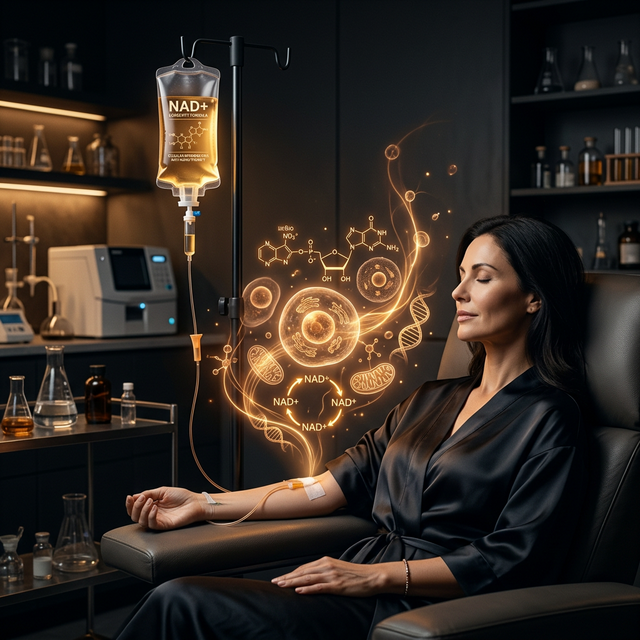
If you spend any time in longevity or biohacking circles, you've encountered NAD+ therapy as something close to a cellular fountain of youth. Clinics promise reversed aging, rejuvenated cells, and restored energy levels that rival those of a decade earlier. The scientific story behind these claims is genuinely remarkable — but also more complicated than the marketing suggests.
This article takes an honest look at what anti-aging science says about NAD+: the striking animal data that started the excitement, the human evidence we actually have, and what you can realistically expect from NAD+ IV therapy as an anti-aging intervention.
Disclaimer: This article is for educational purposes only. NAD+ IV therapy is not FDA-approved for anti-aging or any other indication. Consult a licensed healthcare provider before starting any treatment.
Why NAD+ and Aging Are So Deeply Connected
To understand the anti-aging case for NAD+, you need to understand the hallmarks of aging — the biochemical processes that define biological aging at the cellular level.
The nine hallmarks of aging identified by Lopez-Otin and colleagues (Cell, 2013, updated 2023) include:
- Genomic instability (DNA damage accumulation)
- Loss of proteostasis (protein quality control failure)
- Deregulated nutrient sensing
- Mitochondrial dysfunction
- Cellular senescence
- Altered intercellular communication (chronic inflammation)
NAD+ is intimately involved in multiple of these hallmarks simultaneously:
Genomic instability: PARP1 uses NAD+ to detect and repair DNA breaks. As DNA damage accumulates with age, PARP1 activity increases, consuming more NAD+ and creating a vicious cycle — less NAD+ → less repair capacity → more damage → more PARP1 activation → even less NAD+.
Mitochondrial dysfunction: NAD+ is the central electron carrier in the mitochondrial electron transport chain. Age-related NAD+ decline directly compromises mitochondrial ATP production capacity — the energy deficit underlying age-related fatigue, reduced muscle strength, and cognitive slowdown.
Deregulated nutrient sensing: Sirtuins (SIRT1-7), which require NAD+ for their enzymatic activity, are key regulators of the metabolic adaptation responses associated with longevity — including responses to caloric restriction, exercise, and fasting that mimic lifespan-extending interventions. When NAD+ falls, sirtuin activity drops with it.
Chronic inflammation: SIRT1 deacetylates and inhibits NF-kB, reducing production of pro-inflammatory cytokines. NAD+ depletion → reduced SIRT1 activity → increased inflammatory signaling → inflammaging.
This is not marketing — it is established biochemistry spanning decades of research, including Nobel Prize-winning discoveries.
The Animal Evidence: Remarkably Promising
The preclinical evidence for NAD+ boosting in aging is among the most dramatic in all of longevity science:
The 2013 Sinclair Lab Study (Cell): Harvard's David Sinclair and colleagues published findings showing that NAD+ restoration in old mice (via NMN supplementation) produced measurable reversal of muscle aging within one week — including improved mitochondrial function and restored exercise tolerance. The study received widespread scientific and popular attention and was described as demonstrating "reversal" of aging at the molecular level in muscle tissue.
Lifespan Extension in Model Organisms: NAD+ precursors have extended lifespan in C. elegans (roundworms), Drosophila (fruit flies), and yeast — standard model organisms in aging research. These effects have been reproducibly demonstrated across multiple laboratories.
Neurological Protection: Preclinical data shows NAD+ supplementation protects against amyloid-beta toxicity in Alzheimer's mouse models, improves cognitive performance in aged animals, and supports myelin repair. SIRT1 and SIRT3 have neuroprotective roles that depend on adequate NAD+.
DNA Repair Restoration: A 2019 study in Science demonstrated that NMN treatment restored DNA repair capacity and reversed aspects of vascular aging in aged mice, improving blood flow and exercise capacity.
The Human Evidence: More Limited, But Growing
The transition from mice to humans is where the anti-aging case becomes more qualified. Human studies on NAD+ and aging are genuine but limited by small sample sizes, short duration, and — importantly — most use oral precursors (NMN or NR), not IV NAD+ specifically.
Key Human Studies:
Martens et al. (2018, Nature Communications):
- RCT; n=24 adults aged 55-79; 1,000 mg/day oral NR for 6 weeks
- Result: Blood NAD+ elevated ~60%; aortic stiffness improved in a subgroup
- Evidence quality: Grade B — well-designed but small; oral precursor not IV
Yoshino et al. (2021, Science):
- RCT; n=25 prediabetic postmenopausal women; 250 mg/day oral NMN
- Result: Improved insulin-stimulated muscle glucose disposal (improved insulin sensitivity)
- Evidence quality: Grade A for design; limitation is specificity to one population and oral route
Pencina et al. (2022, Nature Communications):
- Oral NMN in overweight middle-aged adults; improved bioenergetic markers
- Evidence quality: Grade B
For IV NAD+ specifically: The evidence is significantly thinner. No adequately powered, placebo-controlled RCT has evaluated IV NAD+ for anti-aging outcomes (aging biomarkers, physical function, cognitive performance, or any longevity endpoint) in healthy adults.
What exists for IV NAD+ in anti-aging contexts is:
- Observational data from longevity clinics (no controls)
- Patient-reported outcomes (subject to placebo effects and selection bias)
- Pharmacokinetic studies confirming plasma NAD+ elevation following infusion (safety/tolerability data)
- Theoretical extrapolation from the oral precursor and animal data
This is not a reason to dismiss IV NAD+ — it is a reason for calibrated expectations.
What NAD+ IV Therapy May Realistically Do for Anti-Aging
Based on the mechanistic evidence and available human data, here is a realistic assessment:
What Is Plausible
Temporary NAD+ repletion in people with measurable decline: Adults over 50 with documented NAD+ deficiency markers, mitochondrial dysfunction indicators, or chronic metabolic stress may experience genuine biological restoration from IV NAD+ — the equivalent of replenishing a depleted cellular resource rather than artificially enhancing a normal state.
Mitochondrial function improvement: This is the area where the mechanism-to-benefit chain is shortest. NAD+ → electron transport chain efficiency → ATP production. If your mitochondria are NAD+-limited (increasingly likely over age 40), repletion may produce meaningful energy improvement.
DNA repair capacity support: IV NAD+ provides PARP1 with the substrate it needs to repair accumulated DNA damage. Whether this translates into measurable anti-aging outcomes over a meaningful timescale has not been tested in humans.
Sirtuin activation: Restoring NAD+ activates SIRT1 and SIRT3, improving metabolic regulation, reducing inflammation, and potentially slowing some aspects of cellular aging.
What Is Less Certain
Reversing already-established aging changes: While the mouse data shows reversal of specific aging parameters, humans are more complex and longer-lived. The same one-week turnaround seen in old mice is not a realistic clinical expectation in humans.
Long-term lifespan extension: No human data supports this claim. It's a logical extrapolation from model organism data — not an established human outcome.
Aesthetic anti-aging effects (skin, hair, appearance): Some patients report skin improvement after NAD+ infusions. The mechanistic link (DNA repair in skin cells, NAD+-dependent antioxidant protection) is plausible but not validated in dedicated dermatological RCTs.
A Potential Concern: NAD+ and Cancer
This is the aspect of NAD+ anti-aging therapy that deserves more honest discussion than it typically receives in wellness marketing:
NAD+ supports cellular energy metabolism in all cells — including cancer cells. PARP inhibitors (the cancer drugs olaparib, niraparib, rucaparib) work precisely by depleting NAD+ in cancer cells to prevent DNA repair. High-dose NAD+ supplementation in individuals with active or subclinical malignancy raises a genuine theoretical concern.
This does not mean NAD+ therapy causes cancer. But:
- Individuals with a history of or active cancer should obtain oncology clearance before pursuing NAD+ IV therapy
- Patients on PARP inhibitor chemotherapy have an absolute contraindication to IV NAD+
NAD+ Anti-Aging Protocol: What Clinics Typically Offer
Anti-aging/longevity protocol:
- 4-6 sessions over 2-4 weeks (500-750 mg per session)
- Monthly maintenance after completing the initial series
- Oral NMN or NR used between infusions for continuous NAD+ support
- Cost: $300-$600 per session; $1,500-$4,000 for an initial series
The "load then maintain" strategy: Most longevity practitioners use IV NAD+ for initial high-dose repletion — rapidly restoring depleted NAD+ pools — then oral NMN or NR for ongoing maintenance at substantially lower cost. This approach is theoretically sound, though the combination has not been directly tested in RCTs.
How Does NAD+ IV Therapy Compare to Other Anti-Aging Interventions?
| Intervention | Evidence Level | Cost | Time Required |
|---|---|---|---|
| NAD+ IV therapy | Emerging — strong mechanistic; weak IV-specific clinical | $$ | 4-14 hrs/session |
| Oral NMN/NR | Moderate — human RCT data | $ | Daily pill |
| Exercise (resistance + aerobic) | Excellent — best-proven anti-aging intervention | Low | Hours/week |
| Caloric restriction / intermittent fasting | Strong — lifespan data in animals; human metabolic data | Low | Ongoing |
| Senolytic therapy | Early — promising animal data | $ | Periodic protocols |
| EBOO / MAH ozone therapy | Preliminary | $ | 1-2 hrs/session |
The comparison is humbling: exercise remains the most evidence-supported anti-aging intervention at essentially zero cost. NAD+ IV therapy may complement a comprehensive longevity protocol — but should not substitute for established lifestyle foundations.
The Bottom Line: NAD+ for Anti-Aging
The scientific case for NAD+ in aging is real and built on decades of foundational research. Age-related NAD+ decline is measurable, mechanistically significant, and associated with major features of biological aging. The animal data is striking. The human evidence for oral precursors is promising. The human evidence specifically for IV NAD+ in anti-aging is still early-stage.
NAD+ IV therapy is a scientifically rational anti-aging intervention for people who:
- Are over 40 with documented energy decline or metabolic dysfunction
- Want to support their longevity protocol with high-dose periodic NAD+ repletion
- Understand they are investing in a biologically plausible but not yet proven treatment
- Have no contraindications (particularly no active cancer, no PARP inhibitor chemotherapy)
If you're exploring NAD+ for longevity, the most cost-effective, evidence-supported approach is: strong lifestyle foundation + daily oral NMN or NR + periodic IV NAD+ boosts when accessible and affordable.
Related reading:
- What Is NAD+ IV Therapy? The Complete Beginner's Guide
- NAD+ IV vs. NMN and NR: Which Should You Choose?
- NAD+ IV Therapy for Addiction Recovery
- IV Therapy and Advanced Wellness Treatments: The Complete Guide
This article is for educational purposes only. NAD+ IV therapy is not FDA-approved. Consult a licensed healthcare provider before starting any treatment.