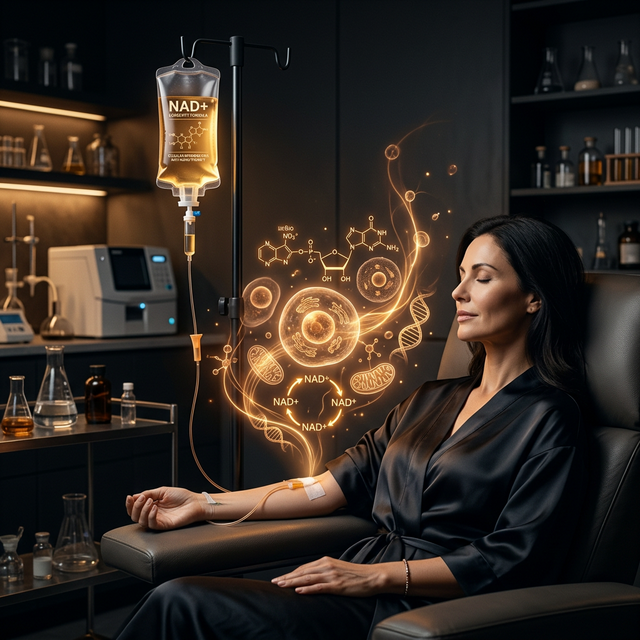
The market for NAD+-boosting products has exploded. IV clinics offer NAD+ infusions starting at $300 per session. Supplement companies sell NMN and NR products ranging from $40 to $200 per month. Longevity researchers argue about which approach best supports cellular health. Meanwhile, you're trying to figure out which — if any — makes sense for you.
This guide cuts through the noise with a direct, evidence-based comparison of IV NAD+, oral NMN, and oral NR: how each works, what the evidence actually supports, what they cost, and when each approach makes most sense.
Disclaimer: This article is for educational purposes only. Consult a licensed healthcare provider before starting any NAD+ supplementation protocol.
Quick Reference: The Three Main NAD+ Boosting Approaches
| Approach | What It Is | Delivery | Bioavailability |
|---|---|---|---|
| IV NAD+ | Direct NAD+ infusion | Intravenous (clinic visit) | 100% |
| Oral NMN | Nicotinamide Mononucleotide | Capsule/powder | 20-40% (estimated) |
| Oral NR | Nicotinamide Riboside | Capsule | 25-50% |
All three ultimately aim to increase cellular NAD+ levels. The differences lie in how efficiently they get there, what the evidence says, how much they cost, and how practical they are for regular use.
Understanding the NAD+ Synthesis Pathways
To compare these approaches intelligently, you need a basic understanding of how the body makes NAD+.
The body manufactures NAD+ through three routes:
- De novo synthesis from tryptophan — dietary tryptophan → via the kynurenine pathway → NAD+
- Preiss-Handler pathway from niacin (B3) — dietary niacin → nicotinic acid mononucleotide → NAD+
- Salvage pathway from nicotinamide (Nam) — the most important route; recycled nicotinamide → NMN → NAD+
NMN and NR are intermediate molecules in these pathways:
- NMN (Nicotinamide Mononucleotide) → directly converted to NAD+ via NMNAT enzymes
- NR (Nicotinamide Riboside) → converted to NMN first, then to NAD+
Direct oral NAD+ does not work effectively because the molecule is too large and charged to survive GI transit intact. NMN and NR are smaller and use dedicated cellular transporters.
IV NAD+: The High-Dose, High-Impact Approach
How It Works
IV NAD+ bypasses the GI tract entirely, delivering 100% of the administered dose directly into the bloodstream. Within minutes, plasma NAD+ concentrations rise to levels pharmacologically impossible through oral intake of NAD+ itself.
Cellular Uptake
The question of how IV NAD+ enters cells was debated for years — and the mechanism turns out to be multi-step: connexin 43 hemichannels and P2X7 purinergic receptors allow some direct cellular uptake. But a significant portion is enzymatically cleaved extracellularly to NMN and NR, which then enter cells via their dedicated transporters and are reconverted to NAD+ intracellularly.
Evidence Strength
IV-specific evidence is the weakest of the three approaches:
- Safety and tolerability studies confirm plasma NAD+ elevation
- Addiction recovery observational data (promising but uncontrolled)
- Anti-aging and cognitive applications: mechanistically sound, clinically unproven in RCTs
Best Use Cases for IV NAD+
- Acute, high-dose repletion (especially in addiction recovery)
- Patients with severe documented NAD+ deficiency or mitochondrial dysfunction
- People who want rapid, maximum-concentration restoration rather than gradual daily supplementation
- Initial "loading" phase before maintaining with oral precursors
Side Effects
Rate-dependent (resolve with slower infusion):
- Chest tightness (30-50%)
- Nausea (30-50%)
- Flushing, headache, muscle cramping
Cost
$200-$900 per session; $3,000-$10,000 for intensive addiction protocols
Oral NMN: The Longevity Supplement with Growing Human Evidence
How It Works
NMN enters cells directly via the Slc12a8 transporter (identified in a key 2019 Nature Metabolism study by Lukyanenko et al.) and is converted intracellularly to NAD+. It also enters the Preiss-Handler pathway in some tissues.
Evidence Strength — The Best of the Three for Human Trials
NMN has the best-emerging human RCT evidence:
Yoshino et al. (2021, Science):
- Well-designed RCT; n=25 prediabetic postmenopausal women
- 250 mg/day oral NMN for 10 weeks
- Result: Significant improvement in muscle insulin sensitivity vs. placebo
- Evidence quality: Grade A (design); limitation is specific population
Pencina et al. (2022, Nature Communications):
- 600 mg/day NMN in overweight middle-aged adults
- Result: Improved bioenergetic markers and NAD+ metabolite elevation
- Evidence quality: Grade B
Fang et al. (2023, Cell Reports Medicine):
- 1,000 mg/day NMN in amateur runners
- Result: Improved aerobic capacity (VO2 max) vs. placebo
- Evidence quality: Grade B; first well-designed study in physically active adults
NMN Bioavailability
Estimated at 20-40% for oral delivery. While lower than IV, consistent daily dosing maintains elevated blood NMN and intracellular NAD+ more sustainably than periodic IV infusions.
NMN Dosing
Effective human doses: 250-1,000 mg/day. Most commercial products offer 250-500 mg capsules.
Best Use Cases for Oral NMN
- Daily maintenance of NAD+ levels after IV loading
- Anti-aging and longevity optimization in adults over 40
- Metabolic health support (insulin sensitivity, energy)
- Athletic performance enhancement
- Cost-effective long-term strategy
Cost
$50-$200/month depending on dose and brand. Substantially more accessible than IV therapy for ongoing use.
Concerns
Quality control: The NMN supplement market has significant product quality variability. Third-party tested products with Certificate of Analysis (CoA) from accredited labs are preferable.
Regulatory status: NMN was briefly subject to an FDA enforcement question (2022-2023) after a drug development company argued it should be classified as a drug ingredient. As of early 2026, NMN remains commercially available as a supplement in the U.S., but the regulatory status bears watching.
Oral NR (Nicotinamide Riboside): The Established NAD+ Precursor
How It Works
NR uses equilibrative nucleoside transporters (ENTs) for cellular entry, is phosphorylated to NMN inside cells, and then converted to NAD+.
Evidence Strength — Most Published Human RCT Data
NR has the longest track record in human trials among NAD+ precursors:
Martens et al. (2018, Nature Communications):
- RCT; n=24 adults aged 55-79
- 1,000 mg/day NR for 6 weeks
- Result: Blood NAD+ elevated ~60%; improved aortic stiffness in a subgroup
- Evidence quality: Grade B
Dollerup et al. (2018, Nature Communications):
- RCT; n=40 obese men; 2,000 mg/day NR
- Result: NAD+ metabolites elevated; limited metabolic effects at this dose in obese adults
- Evidence quality: Grade B; suggests dose-response complexity
Trammel et al. (2016, Scientific Reports):
- Cross-over study; single dose NR; confirmed rapid blood NAD+ elevation in humans
- Evidence quality: Grade B
NR Bioavailability
25-50% oral bioavailability; similar to NMN. NR is well-absorbed and rapidly incorporated into NAD+ synthesis.
NR vs. NMN: The Key Difference
The primary distinction is in the conversion pathway — NR must be converted to NMN before becoming NAD+, while NMN converts directly. In practice, blood NAD+ elevation from both compounds is similar. The main differentiators are:
- Cost: NR is often slightly less expensive than NMN
- Research volume: NR has more published human studies
- Recent data: NMN has newer trials showing potentially superior effects in specific contexts (insulin sensitivity, aerobic capacity)
Nicotinamide (Nam) Caveat
Despite being an effective NAD+ precursor, high-dose nicotinamide is a sirtuin inhibitor — it competitively inhibits SIRT1 at high concentrations. Since sirtuin activation is a central mechanism in NAD+'s anti-aging benefits, nicotinamide supplementation may undermine some of the longevity-related goals. NMN and NR do not share this limitation.
Cost
$40-$150/month. Generally the most affordable NAD+ precursor category.
Full Comparison Table
| Factor | IV NAD+ | Oral NMN | Oral NR |
|---|---|---|---|
| Bioavailability | 100% | 20-40% | 25-50% |
| Speed of action | Minutes | Hours-days | Hours-days |
| Human clinical evidence | Weak (IV-specific) | Moderate, growing | Strongest in class |
| Best evidence for | Addiction recovery, acute repletion | Insulin sensitivity, aerobic performance | Metabolic aging markers |
| Cost per month | $300-$1,500+ | $50-$200 | $40-$150 |
| Convenience | Clinic visit; 2-14 hrs/session | Daily oral | Daily oral |
| Common side effects | Chest tightness, nausea, flushing | Mild GI effects | Mild flushing (low dose) |
| Sirtuin activation | Yes | Yes | Yes |
| Long-term safety data | Limited | Limited | Moderate (longest track record) |
Which Approach Is Right for You?
Choose IV NAD+ if:
- You are in addiction recovery and need acute, high-dose neurochemical support
- You have documented severe NAD+ deficiency or mitochondrial dysfunction
- You want a rapid repletion "loading dose" before maintaining with oral supplements
- Cost and clinic access are not barriers
Choose Oral NMN if:
- You want daily anti-aging and longevity maintenance at reasonable cost
- You're focused on metabolic health or athletic performance
- You want the most recent human trial evidence
- You're maintaining NAD+ levels between IV sessions
Choose Oral NR if:
- You want the longest human clinical track record among oral precursors
- Cost is a primary consideration
- You want a well-tolerated daily supplement with established safety data
The "Load and Maintain" Strategy
Most longevity-focused practitioners use a combination approach:
- IV NAD+ for an initial loading phase (4-8 sessions over 4-8 weeks) to rapidly restore depleted NAD+ pools
- Daily oral NMN or NR for ongoing maintenance between infusions
- Periodic IV "booster" sessions (monthly or quarterly) for sustained high-level support
This is theoretically sound — combining the high bioavailability spike of IV with the consistency of daily oral — though the specific combination has not been studied in controlled trials.
The Bottom Line
There is no single "best" approach to NAD+ supplementation — the right choice depends on your goals, health status, access, and budget.
For acute, high-dose therapeutic repletion (especially addiction recovery): IV NAD+ has the most developed clinical application.
For sustainable daily anti-aging and metabolic support: oral NMN or NR are more practical, more affordable, and have the strongest published human trial data.
For most people: the combination approach — IV loading plus oral maintenance — is the most complete strategy, though also the most expensive.
Related reading:
- What Is NAD+ IV Therapy? The Complete Beginner's Guide
- NAD+ IV Therapy for Anti-Aging: What the Research Shows
- IV Drips vs. Oral Supplements: What the Evidence Shows
- How Much Does IV Therapy Cost?
This article is for educational purposes only. Consult a licensed healthcare provider before starting any NAD+ protocol. Regulatory status of supplements may change — verify current status before purchase.