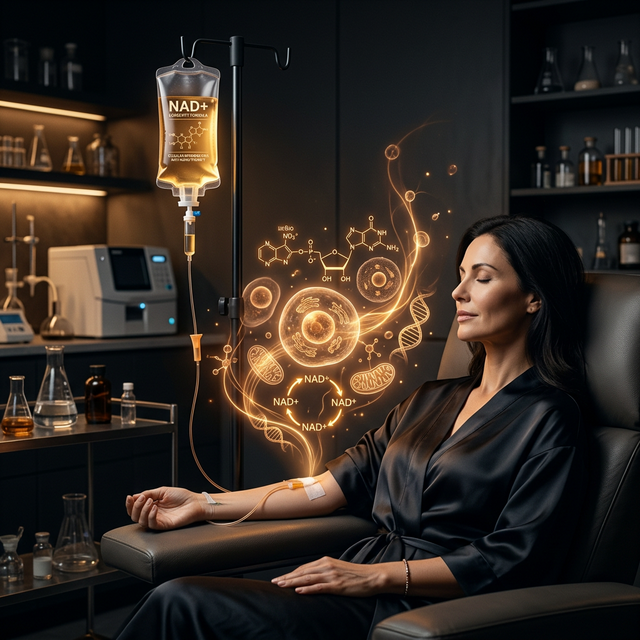
NAD+ IV therapy has become one of the most talked-about treatments in the worlds of anti-aging medicine, addiction recovery, and biohacking. You might have heard it described as a "cellular fountain of youth" or a tool for beating addiction without withdrawal symptoms. The scientific story behind it is genuinely compelling — though some of the marketing has gotten ahead of the evidence.
This guide explains exactly what NAD+ is, why it declines with age, why IV delivery is used instead of oral supplements, what the treatment is claimed to do, and what you can honestly expect based on the current research.
Disclaimer: This article is educational and does not constitute medical advice. NAD+ IV therapy is not FDA-approved for any specific indication. Always consult a licensed healthcare provider.
What Is NAD+?
NAD+ stands for Nicotinamide Adenine Dinucleotide. Despite the intimidating name, it's not a vitamin, drug, or exotic compound — it's a coenzyme that your body already produces and that is present in every single cell.
The "+" indicates its oxidized form (which is the metabolically active form that accepts electrons). When NAD+ accepts electrons, it becomes NADH — which then donates those electrons to the mitochondrial electron transport chain to generate ATP (energy). This cycling between NAD+ and NADH is one of the most fundamental energy-generating processes in all of biology.
Beyond energy production, NAD+ performs three other critical biological roles:
1. Sirtuin Activation (SIRT1-SIRT7) Sirtuins are a family of NAD+-dependent proteins that regulate gene expression, DNA repair, mitochondrial biogenesis, and metabolic adaptation. They are widely studied as longevity-associated proteins — and they require NAD+ to function. If NAD+ levels drop, sirtuin activity falls with them.
2. DNA Repair via PARP Enzymes PARP1 (poly-ADP-ribose polymerase) is the body's DNA damage detection and repair system. When your cells detect DNA strand breaks — from UV exposure, oxidative damage, or normal replication errors — PARP1 consumes large quantities of NAD+ to initiate repair. This is important: the more DNA damage accumulates (as happens with aging), the more NAD+ gets consumed by PARP1.
3. CD38 and Calcium Signaling CD38 is an NAD+-consuming enzyme involved in immune cell signaling and calcium homeostasis. It becomes more active with age and is a major driver of age-related NAD+ depletion.
Why Does NAD+ Decline With Age?
NAD+ levels decline measurably and significantly with age. Research published in PLOS ONE (Massudi et al., 2012) quantified NAD+ in human skin tissue and found approximately a 50% decline between the ages of 40 and 60. Similar declines have been documented in blood cells and skeletal muscle.
Four primary mechanisms drive this decline:
- Increased PARP1 activation — accumulated DNA damage with aging drives PARP1 to consume more NAD+
- CD38 upregulation — driven by chronic low-grade inflammation ("inflammaging"), CD38 activity increases dramatically with age, consuming NAD+ at higher rates
- Reduced NAMPT activity — NAMPT is the rate-limiting enzyme in the NAD+ salvage pathway (the main way cells recycle and regenerate NAD+); its activity declines with age
- Reduced dietary precursor intake and gut microbiome changes — aging affects tryptophan metabolism and gut bacteria that synthesize NAD+ precursors
What does this decline cause?
- Reduced ATP production capacity → fatigue, reduced physical and cognitive performance
- Impaired DNA repair → increased cellular aging and cancer risk
- Decreased sirtuin activity → impaired metabolic regulation, inflammation control, and stress response
- Heightened chronic inflammation → accelerated aging of all tissues
This is not theoretical aging science. These declines are measured in human tissue samples. The question NAD+ therapy asks: can reversing this decline produce meaningful clinical benefit?
Why IV? Why Not Just Take NAD+ Orally?
This is the most common question about NAD+ therapy, and the answer has genuine scientific substance:
NAD+ is a large, charged molecule (molecular weight: 663.4 g/mol). When you ingest NAD+ orally, stomach acid and intestinal enzymes rapidly break it down before it can be absorbed in meaningful quantities. The GI tract essentially destroys the molecule before it reaches systemic circulation.
IV administration bypasses this entirely. An IV infusion of NAD+ achieves 100% bioavailability — every milligram administered enters the bloodstream immediately. It can produce plasma concentrations that are pharmacologically impossible through oral intake of NAD+ itself.
What about oral precursors (NMN and NR)? This is where it gets nuanced. Nicotinamide Mononucleotide (NMN) and Nicotinamide Riboside (NR) are smaller molecules that the body converts into NAD+. They do have meaningful oral bioavailability — demonstrated in human clinical trials:
- Martens et al. (2018, Nature Communications): Oral NR at 1,000 mg/day elevated blood NAD+ by ~60% in adults aged 55-79
- Yoshino et al. (2021, Science): Oral NMN improved insulin sensitivity in prediabetic women in a well-designed RCT
The comparison is important: oral precursors (NMN, NR) have stronger clinical trial evidence than IV NAD+ itself. IV NAD+ has the bioavailability advantage but a thinner clinical trial base.
The practical consensus among practitioners: IV NAD+ is used for acute, high-dose repletion (especially in addiction recovery, severe deficiency, or acute clinical need), while oral NMN or NR maintain NAD+ levels between infusions. For more on this, see: NAD+ IV vs. NMN and NR: Which Should You Choose?
How Does a NAD+ IV Infusion Work?
What's In the Bag?
A standard NAD+ IV preparation contains:
- NAD+ (250-1,000 mg or more, depending on the protocol)
- Sterile carrier solution — 0.9% normal saline or D5W (dextrose in water)
- Often combined with: vitamin C, B-complex vitamins, magnesium, and amino acids
- pH-adjusted to physiological ranges
NAD+ is a compounded medication prepared by a licensed compounding pharmacy. There are no FDA-approved commercial IV NAD+ products.
What Happens During the Infusion?
Infusion rate is critical. NAD+ cannot be infused quickly without causing significant side effects (see below). Standard infusion rates are 25-100 mg/hour — meaning a 500 mg infusion takes 4-6 hours, and higher doses can take 8-14 hours.
At the cellular level during and after infusion:
- Blood plasma NAD+ concentrations rise within minutes
- Cellular uptake occurs through connexin 43 hemichannels and purinergic receptors
- Intracellularly: SIRT1 activation drives mitochondrial biogenesis via PGC-1alpha; SIRT3 optimizes mitochondrial complex activity; SIRT6 promotes DNA repair
- NAD+/NADH ratio improves, enhancing oxidative phosphorylation efficiency
- SIRT1 deacetylates NF-kB, reducing inflammatory cytokine production
What Is NAD+ IV Therapy Used For?
1. Addiction Recovery — Best-Supported Clinical Application
Chronic substance use — alcohol, opioids, methamphetamine, benzodiazepines, nicotine — severely depletes neuronal NAD+. This depletion disrupts dopaminergic signaling, worsens withdrawal symptoms, and impairs the brain's natural repair processes.
IV NAD+ in addiction recovery has been studied in observational series:
- The BrainNAD Foundation and Dr. Richard Mestayer's clinic have documented hundreds of patients treated with 10-day high-dose IV NAD+ protocols for addiction (750-1,500 mg/day)
- A 2020 pilot study by Trescot et al. in the Journal of Alternative and Complementary Medicine showed significant reduction in opioid withdrawal symptom scores with IV NAD+
- Patients consistently report reduced craving severity, milder withdrawal experiences, and faster return of mood stability
Important caveat: These studies lack placebo controls and have small sample sizes. The addiction recovery application has the most developed clinical use — but still awaits properly controlled trials. It must be adjunctive to comprehensive addiction treatment, not a standalone cure.
2. Energy and Chronic Fatigue
The most consistently reported patient experience after NAD+ infusions. The mechanistic basis is direct: NAD+ depletion impairs ATP production; repletion restores it. Patients with documented chronic fatigue — including ME/CFS, Long COVID fatigue, and age-related energy decline — are among the most motivated seekers of NAD+ therapy.
3. Cognitive Function and Brain Fog
NAD+ is critical for neuronal energy metabolism and neuroprotection. Preclinical models show:
- Protection against amyloid-beta toxicity (Alzheimer's-related)
- Improved cognitive performance in aged animals with NAD+ restoration
- SIRT1 and SIRT3 mediated neuroprotection
Patients commonly report reduced "brain fog" and improved mental clarity within 1-3 sessions. Note: NAD+ does not readily cross the blood-brain barrier directly — brain benefits are likely mediated indirectly through improved cerebrovascular energetics and reduced systemic inflammation.
4. Anti-Aging and Longevity
The scientific case for NAD+ in aging is built on striking preclinical data — including a 2013 Cell paper by Sinclair Lab at Harvard showing that NAD+ restoration reversed aspects of muscle aging in old mice within one week. However, no human RCT has demonstrated life extension or definitive reversal of aging biomarkers with IV NAD+ specifically. This is the area where scientific promise is greatest and clinical proof is thinnest. See: NAD+ IV Therapy for Anti-Aging: What the Research Shows
5. Metabolic Health and Athletic Performance
A 2021 Science RCT by Yoshino et al. (oral NMN, n=25, prediabetic women) showed improved muscle insulin sensitivity. A 2023 Cell Reports Medicine study showed oral NMN improved aerobic capacity in amateur runners. Direct IV NAD+ evidence for athletic performance is sparse — these oral precursor results are extrapolated.
NAD+ IV Therapy Side Effects
Side effects are primarily rate-dependent — they occur with faster infusion and resolve when the rate is slowed. This is why slow infusion protocols are non-negotiable.
| Side Effect | Estimated Frequency |
|---|---|
| Chest tightness/pressure | 30-50% |
| Nausea | 30-50% |
| Flushing/warmth | 20-40% |
| Headache | 20-35% |
| Abdominal cramping | 15-25% |
| Muscle cramping | 10-20% |
| Anxiety/restlessness | 10-20% |
| Palpitations | 5-15% |
Serious adverse events (rare): cardiac arrhythmia (SVT, AFib reported with rapid infusion) — patients with cardiac history should have a pre-treatment ECG.
Critical drug interaction: PARP inhibitors (cancer drugs: olaparib, niraparib, rucaparib) — IV NAD+ directly antagonizes their cancer-fighting mechanism. This is an absolute contraindication without oncology clearance.
How Much Does NAD+ IV Therapy Cost?
| Dose | Approximate US Cost Per Session |
|---|---|
| Low (250-500 mg) | $200-$400 |
| Standard (500-750 mg) | $350-$600 |
| High (750-1,000 mg) | $500-$900 |
| Addiction protocol (10 days, 750-1,500 mg/day) | $3,000-$10,000 total |
Insurance does not cover NAD+ IV therapy. It is fully out-of-pocket. For ongoing maintenance, oral NMN or NR ($50-$200/month) is far more cost-effective than regular infusions.
See the full cost breakdown: How Much Does IV Therapy Cost? A Complete Price Guide
The Bottom Line
NAD+ IV therapy delivers a biologically essential coenzyme that genuinely declines with age and is poorly absorbed orally. The scientific rationale is grounded in decades of Nobel Prize-winning biochemistry. The preclinical evidence is striking. The clinical trial data, particularly for IV-specific delivery, is still developing.
The most evidence-supported application is addiction recovery. For energy, cognition, and longevity applications, patients should approach IV NAD+ as a biologically rational adjunctive intervention — not a proven cure or replacement for established treatments.
Related reading:
- NAD+ IV Therapy for Anti-Aging: What the Research Shows
- NAD+ IV Therapy for Addiction Recovery
- NAD+ IV vs. NMN and NR: Which Should You Choose?
- IV Therapy and Advanced Wellness Treatments: The Complete Guide
This article is for educational purposes only. NAD+ IV therapy is not FDA-approved. Consult a licensed healthcare provider before starting any IV or wellness treatment.