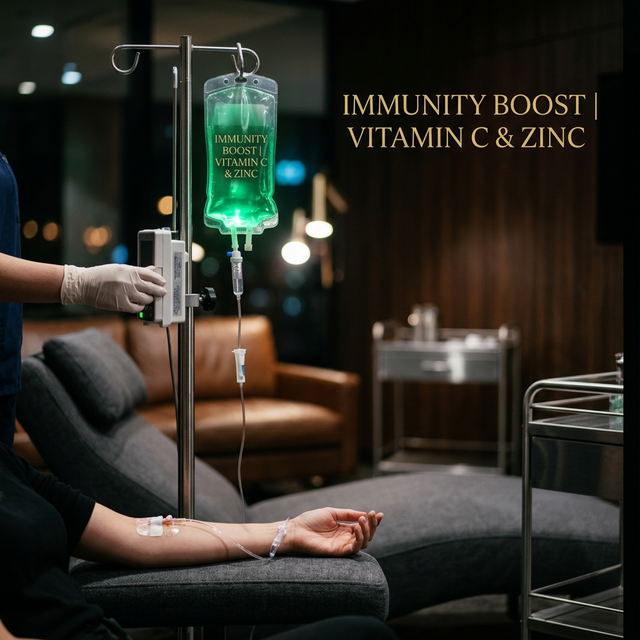
Vitamin C is probably the most familiar nutrient in the supplement aisle — and arguably the most thoroughly understood from a pharmacokinetic standpoint. But there's a profound difference between the vitamin C in your daily multivitamin and the high-dose intravenous vitamin C used in clinical settings. The doses are different by orders of magnitude. The mechanisms at play are fundamentally different. And the evidence base is more substantial than most people realize.
This guide covers everything clinically relevant about high-dose IV vitamin C: the pharmacokinetics that make IV necessary for pharmacological doses, what the evidence shows for immune support, viral illness, cancer supportive care, and post-illness recovery — and what you need to know about safety.
Disclaimer: This article is for educational purposes only. High-dose IV vitamin C is not FDA-approved as a treatment for any condition. Consult a licensed healthcare provider before pursuing any IV therapy.
The Pharmacokinetics: Why High Doses Require IV
This is the most important concept to understand about IV vitamin C — and it's not marketing; it's rigorous NIH-funded research.
When you take vitamin C orally, it is absorbed through the small intestine via two specific sodium-dependent vitamin C transporters (SVCT1 and SVCT2). These transporters have a finite capacity — they become saturated at relatively low doses:
- 200 mg oral dose: Plasma vitamin C ~8-10 micromolar (uM)
- 1,000 mg oral dose: Plasma vitamin C ~70-80 uM (absorption efficiency plummets due to transporter saturation; excess excreted in urine)
- 4,000 mg oral dose (near-megadose): Plasma vitamin C ~80-85 uM — barely higher than 1,000 mg
This saturation ceiling exists regardless of how much you take orally. You cannot achieve higher plasma vitamin C by simply taking more pills.
By contrast, IV administration:
- 25g IV: Plasma vitamin C ~2,000-5,000 uM
- 100g IV: Plasma vitamin C can exceed 20,000 uM
This is documented in a series of pharmacokinetic studies by Dr. Mark Levine's team at the NIH, published in PNAS (1996) and Annals of Internal Medicine (2004) — foundational work that is rigorous, well-replicated, and peer-reviewed.
Why does this matter? The biological effects of vitamin C at pharmacological concentrations (1,000+ uM) are qualitatively different from its effects at physiological concentrations (80 uM). Different mechanisms activate at different concentration thresholds.
Mechanism of Action: How High-Dose IV Vitamin C Works
At Physiological Concentrations (80-200 uM — Achievable Orally)
- Acts as an electron donor antioxidant — neutralizes reactive oxygen species
- Accumulates in neutrophils and lymphocytes (10-100x plasma levels) — supports immune cell chemotaxis, phagocytosis, and killing capacity
- Cofactor for prolyl hydroxylase and lysyl hydroxylase — essential for collagen synthesis and cross-linking
- Regenerates vitamin E from its oxidized form
- Required for catecholamine synthesis (dopamine, norepinephrine)
At Pharmacological Concentrations (1,000-20,000+ uM — Only Achievable by IV)
The pro-oxidant paradox: At millimolar concentrations, ascorbate paradoxically acts as a pro-oxidant rather than an antioxidant. The mechanism:
- Ascorbate reacts with free ferric iron (Fe³⁺) in the extracellular space, reducing it to ferrous iron (Fe²⁺)
- Ferrous iron reacts with hydrogen peroxide via the Fenton reaction: Fe²⁺ + H₂O₂ → Fe³⁺ + OH⁻ + •OH (hydroxyl radical)
- Ascorbate also directly generates H₂O₂ extracellularly at high concentrations
Why is this selective? Normal cells have abundant intracellular catalase, glutathione peroxidase, and other H₂O₂-neutralizing enzymes — they neutralize the H₂O₂ before it causes harm. Cancer cells and certain pathogens have significantly lower antioxidant enzyme capacity — making them selectively vulnerable to the H₂O₂ generated by pharmacological vitamin C.
This is the mechanism underlying high-dose IV vitamin C's investigation in oncology and severe infection.
NF-kB inhibition at high concentrations: Pharmacological vitamin C downregulates NF-kB — the master transcription factor for pro-inflammatory cytokine production — reducing cytokine storm-type inflammatory responses.
What High-Dose IV Vitamin C Is Used For
1. Cancer Supportive Care — Best-Developed Evidence
This is where high-dose IV vitamin C has the most substantial evidence base:
Riordan Clinic (National Riordan Research Institute): Decades of clinical research on high-dose IV vitamin C (25-100g) in cancer patients:
- Improved quality of life metrics
- Reduced fatigue, pain, and nausea associated with chemotherapy/radiation
- Reduced inflammatory markers (C-reactive protein, IL-6)
- Possible direct cytotoxic effects on tumor cells via H₂O₂ mechanism
NIH-funded studies: A Phase II trial at the NIH (Cameron, Padayatty, Levine et al.) documented multiple cancer patients receiving high-dose IV vitamin C with prolonged survival exceeding statistical expectation — though case series, not RCTs.
Recent systematic review: A 2021 systematic review in Integrative Cancer Therapies of 21 studies found consistent evidence of improved quality of life and reduced chemotherapy toxicity with high-dose IV vitamin C as adjunct to cancer care.
Critical note: High-dose IV vitamin C is adjunctive cancer support — it does not replace standard cancer treatment and is not proven to cure any cancer.
Vitamin C-Chemotherapy Interactions:
- Vitamin C does NOT interfere with most conventional chemotherapy agents — an outdated concern
- However, vitamin C should be paused around some platinum-based chemotherapy sessions (cisplatin) — discuss with oncologist
- Contraindicated with certain targeted therapies — oncologist consultation is mandatory
2. Severe Viral Infections and Respiratory Illness
Mechanism: At pharmacological IV concentrations, vitamin C generates H₂O₂ that disrupts viral replication machinery and inactivates viral capsid proteins — while the antiviral immune response is simultaneously supported.
COVID-19 research:
- Multiple hospital studies in Italy, China, and the US evaluated IV vitamin C (6-24g/day) in severe COVID-19
- A 2021 meta-analysis (Critical Care Medicine, Hemila & Chalker): High-dose IV vitamin C reduced ICU length of stay across multiple critical illness studies including COVID-19 — meaningful but not definitive
- The overall COVID-19 RCT data is mixed, complicated by dosing variations and patient population differences
Upper respiratory infections:
- A 2019 meta-analysis in Nutrients confirmed vitamin C reduces URTI duration — with particularly strong effects in high-stress populations (50% reduction in cold incidence in military recruits and marathon runners)
3. Sepsis and Critical Care
HAT Protocol: The Marik et al. 2017 Chest paper reported dramatic mortality reduction with IV vitamin C + hydrocortisone + thiamine (HAT protocol) in sepsis. Subsequent larger RCTs showed more modest results — but the debate about patient selection and timing of administration continues.
Overall evidence in critical care: Promising but not definitively established; ongoing clinical trials are refining the evidence.
4. Post-Illness and Fatigue Recovery
Post-viral fatigue syndromes — including post-COVID, post-influenza, and post-EBV fatigue — have been addressed with high-dose IV vitamin C in integrative medicine settings:
- Vitamin C is rapidly depleted during acute infection
- Adrenal glands require high vitamin C concentrations for cortisol synthesis — critical during physiological stress recovery
- Post-illness oxidative stress burden is addressed by high-dose antioxidant delivery
Controlled evidence is limited, but the mechanistic rationale and patient-reported outcomes from integrative practice are consistently positive.
High-Dose IV Vitamin C Doses and Protocols
| Application | Dose Range | Infusion Frequency |
|---|---|---|
| Wellness/immune support | 5-15g | Weekly to monthly |
| Acute viral illness support | 15-25g | Daily to 3x/week during illness |
| Cancer supportive care | 25-75g | 2-3x/week |
| Severe COVID-19 (hospitalized) | 6-24g/day | Continuous or divided doses |
Infusion time: Approximately 1g per 10 minutes is a standard rate; higher doses take proportionally longer. A 25g infusion typically runs 60-90 minutes.
Safety of High-Dose IV Vitamin C
Common Side Effects
- Vein irritation: Ascorbate solution is acidic; pH-adjusted (buffered) preparations reduce vein discomfort. Sodium ascorbate is preferred over ascorbic acid for IV due to lower acidity.
- Osmotic discomfort: At very high doses, the hyperosmolarity of concentrated ascorbate can cause mild GI cramping — managed by diluting in adequate carrier volume.
- Temporary nausea: Uncommon at moderate doses; more prevalent at >50g.
The Critical Safety Issue: G6PD Deficiency
G6PD (glucose-6-phosphate dehydrogenase) deficiency is an absolute contraindication to high-dose IV vitamin C.
At pharmacological plasma concentrations, vitamin C generates H₂O₂ that normal RBCs handle via GPx (which requires NADPH, produced by G6PD). In G6PD-deficient individuals, this pathway is impaired — H₂O₂ accumulates in red blood cells, causing acute hemolysis (destruction of red blood cells).
At standard wellness doses (5-15g), risk is lower but still present. At pharmacological cancer-supportive doses (25-75g), hemolytic anemia is a real risk in G6PD-deficient patients.
G6PD testing is mandatory before high-dose IV vitamin C (generally doses above 10-15g).
Kidney Stone Concern
High-dose vitamin C increases urinary oxalate excretion — oxalate is a vitamin C metabolic byproduct. In patients with a history of calcium oxalate kidney stones, repeated high-dose IV vitamin C may increase stone formation risk. This is a relative contraindication requiring individualized assessment.
IV Vitamin C vs. Oral Vitamin C for Immune Support
| Factor | Oral Vitamin C | High-Dose IV Vitamin C |
|---|---|---|
| Maximum plasma concentration | ~80-85 uM | 5,000-20,000+ uM |
| Mechanism available | Antioxidant, immune support | Antioxidant + pro-oxidant + antiviral + anti-inflammatory |
| Evidence for immune support | Strong (for deficiency correction) | Moderate-strong (for acute illness) |
| Cost | Very low ($5-$30/month) | $200-$500 per session |
| Availability | Universal | Requires IV clinic |
| Appropriate for | Daily baseline immune support | Acute illness, cancer support, post-illness recovery |
For daily immune maintenance, oral vitamin C (500-1,000mg) is adequate and evidence-supported. High-dose IV vitamin C provides pharmacological mechanisms inaccessible orally — relevant specifically during acute illness, cancer treatment, or recovery.
See: IV Drips vs. Oral Supplements: What the Evidence Shows
The Bottom Line
High-dose IV vitamin C is one of the most pharmacologically well-characterized of all IV wellness treatments. The pharmacokinetic case for IV delivery (NIH-documented plasma concentration superiority) is scientifically unassailable. The evidence for cancer supportive care and acute viral illness support is meaningful, with ongoing clinical trials continuing to define its role.
The distinction between "oral vitamin C" and "high-dose IV vitamin C" is not primarily about brand or formulation — it's a fundamentally different pharmacological territory. At 25-75g IV, vitamin C behaves like a different drug than the 500mg capsule you take daily.
G6PD testing before high-dose sessions is non-negotiable. At appropriate doses under qualified clinical supervision, high-dose IV vitamin C has an excellent safety profile.
Related reading:
- Immunity IV Drip Benefits: What the Science Actually Supports
- The Myers' Cocktail: Everything You Need to Know
- IV Drips vs. Oral Supplements: What the Evidence Shows
- IV Therapy Safety Guide
- IV Therapy and Advanced Wellness Treatments: The Complete Guide
This article is for educational purposes only. High-dose IV vitamin C is not FDA-approved as a treatment for any condition. Always consult a licensed healthcare provider, and disclose to your oncologist if you are receiving cancer care.