Not everyone is a candidate for IV therapy. And more importantly — not everyone who could receive IV therapy needs it. The gap between "this person could tolerate IV therapy" and "IV therapy offers this person clinically meaningful benefit over what oral supplements provide" is wider than the wellness industry typically acknowledges.
This guide is designed to help you honestly evaluate whether IV therapy makes sense for your specific situation — which type of treatment is most appropriate for your goals, and when your money and effort would be better directed elsewhere.
Disclaimer: This article is for educational purposes only. Consult a licensed healthcare provider to determine whether any IV therapy is appropriate for your individual health circumstances.
The Honest Starting Point: IV Therapy Is Not for Everyone
Before exploring who benefits, it's worth acknowledging who doesn't:
IV therapy offers less incremental benefit to:
- Well-nourished, healthy adults with no documented deficiencies and excellent dietary habits
- People who can achieve the same outcome with high-quality oral supplementation
- Those seeking a "quick fix" for chronic conditions better addressed with lifestyle changes (exercise, sleep, nutrition)
The biological reality: IV therapy works best when it's addressing a genuine delivery problem (GI malabsorption), a concentration requirement that oral intake cannot meet (pharmacological vitamin C), or an acute depletion that requires rapid correction (addiction recovery, post-viral fatigue). It adds the least measurable value when the oral route is functioning well and the clinical goal doesn't require pharmacological concentrations.
With that context established — here is who benefits most from each type of IV therapy.
Who Benefits Most From Immunity IV Drips
Ideal Candidates
1. People with documented or suspected micronutrient deficiencies The most clearly evidence-supported use case. If blood work shows low vitamin C, zinc, magnesium, or B vitamins — IV delivery corrects deficiency faster and more reliably than oral supplementation, particularly in individuals whose GI absorption is compromised.
Signs you may have relevant deficiencies: Frequent infections, slow wound healing, persistent fatigue, mouth sores, brittle nails, unexplained muscle cramps, mood disturbances.
2. Individuals with GI malabsorption conditions
- Inflammatory bowel disease (Crohn's, ulcerative colitis)
- Celiac disease (even when on a gluten-free diet, residual malabsorption is common)
- Post-bariatric surgery (gastric bypass significantly impairs nutrient absorption)
- Chronic pancreatitis
- Short bowel syndrome
For these patients, the pharmacokinetic argument for IV is at its strongest — oral supplementation literally cannot reliably deliver adequate nutrient concentrations.
3. People currently ill with viral infections During acute viral illness, GI absorption changes, appetite decreases, and nutrient demands surge simultaneously. IV delivery bypasses GI limitations at precisely the time when they're most pronounced. High-dose IV vitamin C (10-25g) during acute viral illness has the most clinically rational evidence base of any acute wellness application.
4. People recovering from illness with significant fatigue Post-viral fatigue (post-COVID, post-influenza, post-EBV) involves genuine nutritional depletion alongside mitochondrial dysfunction and immune dysregulation. IV therapy — particularly Myers' Cocktail or immune-enhanced protocols — addresses several of these mechanisms simultaneously.
5. High-performance athletes with elevated nutritional demands Elite athletes have substantially higher micronutrient turnover due to exercise-induced oxidative stress, sweat losses, and accelerated tissue repair. Periodic IV micronutrient replenishment may offer marginal performance or recovery benefit — though this is the area with the thinnest controlled trial evidence.
Who Benefits Most From NAD+ IV Therapy
Ideal Candidates
1. Adults over 40 with documented fatigue or cognitive decline NAD+ levels decline measurably by 40-60% between youth and middle age. Adults with fatigue, brain fog, or reduced physical and cognitive performance that correlates with metabolic decline are the most biologically appropriate candidates.
Relevant pre-treatment markers to discuss with your provider: Mitochondrial function biomarkers, NAD+ metabolite panels (available from specialized labs), lactate/pyruvate ratio.
2. Individuals in active addiction recovery Chronic substance use depletes neuronal NAD+ severely. IV NAD+ has the most developed clinical use in this specific context. Should be pursued as adjunct to comprehensive addiction treatment — not as a standalone therapy.
Best suited for recovery from: Alcohol dependence, opioid use disorder, methamphetamine, benzodiazepines, nicotine.
3. People with chronic fatigue syndromes (ME/CFS, Long COVID) The mitochondrial dysfunction and reduced NAD+-dependent cellular energy production documented in ME/CFS and Long COVID make these patients plausible candidates for NAD+ support — though controlled trial evidence remains preliminary.
4. Longevity-focused adults seeking biological optimization Health-optimizing individuals over 40 interested in supporting the NAD+-sirtuin axis for healthspan and longevity. These individuals benefit from understanding that IV NAD+ provides an acute repletion benefit best complemented by ongoing oral NMN or NR supplementation.
5. Neurological support — TBI, early cognitive impairment (with specialist oversight) NAD+'s neuroprotective mechanisms (SIRT1, SIRT3, DNA repair in neurons) make it theoretically relevant for TBI recovery and early neurodegenerative processes. Requires neurologist involvement.
Not Appropriate
- Anyone with active malignancy (oncology clearance required)
- Patients on PARP inhibitor chemotherapy (absolute contraindication)
- People with unstable cardiac arrhythmias
- Pregnant or breastfeeding individuals
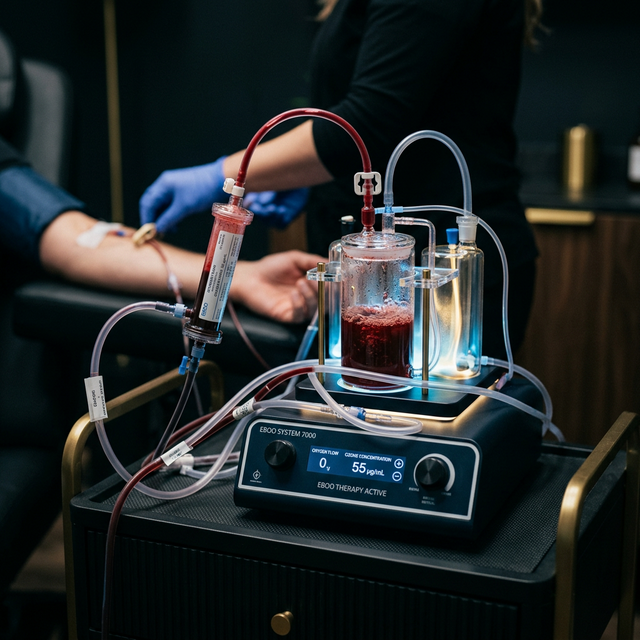
Who Benefits Most From EBOO and Ozone Therapy
Ideal Candidates
1. Adults with chronic fatigue not responding to conventional approaches If standard workup has ruled out other causes and fatigue persists, ozone therapy's mechanisms — improved cellular oxygenation, Nrf2 antioxidant upregulation, immune modulation — address plausible underlying drivers.
2. Individuals with chronic inflammatory conditions Ozone therapy at therapeutic doses reduces chronic inflammatory cytokines (TNF-alpha, IL-1beta) while simultaneously upregulating antioxidant enzymes — a mechanism directly relevant to conditions driven by persistent low-grade inflammation.
3. Peripheral circulation concerns Ozone's well-documented effects on RBC deformability, nitric oxide promotion, and blood viscosity reduction make it particularly relevant for patients with peripheral arterial disease, Raynaud's phenomenon, or other microcirculatory concerns.
4. People with chronic infections (adjunctive support) Those managing Lyme disease co-infections, chronic viral conditions (EBV reactivation, CMV), or recurrent infections may benefit from ozone's indirect antimicrobial and immune-stimulating effects as adjunctive (not curative) support.
5. Patients who have had positive response to other ozone modalities and want more intensive treatment (EBOO specifically) If standard MAH ozone therapy has produced positive results, EBOO represents the logical step-up for more comprehensive treatment.
Absolute Exclusions
- G6PD deficiency — this is non-negotiable
- Active pregnancy
- Uncontrolled hyperthyroidism
- Active bleeding disorders
- Recent MI (within 6 months)
- Severe anemia (Hb < 7 g/dL)
Who Benefits Most From Beauty IV Drips
Ideal Candidates
1. People with hyperpigmentation concerns Melasma, sun damage, post-inflammatory hyperpigmentation from acne or eczema — these are the skin concerns with the most direct mechanistic alignment to glutathione's tyrosinase inhibition mechanism.
2. Individuals with skin-affecting micronutrient deficiencies Skin quality is genuinely impaired by deficiencies of vitamin C, zinc, biotin, and B12. If dietary intake is poor or absorption is compromised, IV correction can produce noticeable skin improvements. This is deficiency correction — not aesthetic enhancement beyond normal function.
3. Those integrating IV therapy into a comprehensive skincare strategy Beauty drips are most rationally positioned as one component of a broader approach: consistent topical skincare (retinoids, SPF), adequate nutrition, sleep, and hydration. As part of this foundation — not a replacement for it.
4. People seeking skin anti-aging support alongside other longevity interventions The antioxidant effects of IV glutathione, vitamin C, and ALA directly address oxidative stress-driven skin aging. For individuals already investing in a comprehensive longevity protocol, adding periodic beauty drips is a logical extension.
Not the Right Primary Approach For
- Anyone expecting dramatic results from a single session
- People with skin concerns better addressed by evidence-based dermatological treatments (prescription retinoids, professionally administered procedures)
- Those with G6PD deficiency (for high-dose protocols)
- Pregnant individuals
A Decision Framework: Is IV Therapy Right for You?
Work through these questions honestly:
Step 1: Do I have a documented medical indication?
- GI malabsorption condition → IV therapy is medically rational
- Documented nutrient deficiency → IV is efficient for correction
- Active substance use disorder in recovery → NAD+ IV has developed clinical application
If yes: IV therapy has a clear, evidence-supported rationale for your situation. Discuss with your primary care provider.
Step 2: Do I have a specific clinical goal that requires pharmacological concentrations?
- Need vitamin C above 5g for immune or cancer support → requires IV
- Need NAD+ for acute high-dose neurochemical repletion → requires IV
If yes: the pharmacokinetic argument for IV is strong.
Step 3: Am I adequately nourished and GI-functional with no specific clinical needs?
If yes: reconsider whether the benefit of IV over optimized oral supplementation is proportional to the cost and inconvenience. A solid oral supplement foundation and lifestyle optimization may deliver comparable outcomes for maintenance.
Step 4: Have I addressed lifestyle fundamentals?
- Regular exercise (the most proven anti-aging and immune intervention)
- Adequate sleep (7-9 hours/night)
- Anti-inflammatory dietary pattern
- Stress management
IV therapy adds meaningful benefit on top of these foundations. It adds less on top of poor foundations.
Who Should Definitely Not Get IV Therapy Without Specialist Clearance
Some groups require specialist consultation before any IV wellness therapy:
| Group | Reason | Clearance Needed From |
|---|---|---|
| Cancer patients (current or recent) | NAD+ pro-cancer concern; vitamin C-chemo interactions | Oncologist |
| Organ transplant recipients | Ozone/NAD+ may interact with immunosuppressants | Transplant specialist |
| G6PD-deficient patients | Cannot receive ozone, EBOO, or high-dose IV vitamin C | Hematologist |
| Cardiac arrhythmia history | NAD+ requires ECG evaluation; some ozone protocols | Cardiologist |
| Pregnancy | Most IV therapies have insufficient safety data | Obstetrician |
| Severe renal or hepatic impairment | Altered drug metabolism and clearance | Nephrologist / Hepatologist |
| Patients on anticoagulants | Ozone + anticoagulants = additive bleeding risk | Prescribing physician |
| Children under 18 | Limited pediatric safety data for most IV wellness therapies | Pediatrician |
The Bottom Line
IV therapy offers genuine, well-documented benefits for specific people in specific situations. The ideal IV therapy candidate is someone with a clear reason the IV route is necessary or meaningfully superior — whether that's a malabsorption condition, a pharmacological concentration requirement, or an acute clinical need like addiction recovery.
The least appropriate candidate is a healthy, well-nourished adult expecting IV therapy to substitute for the established pillars of health: exercise, sleep, diet, and stress management. IV therapy is a powerful adjunct to good health practices — not a replacement for them.
Know your health status, understand your goals, choose the right therapy type, work with a qualified provider, and set expectations calibrated to what the evidence actually supports. That approach consistently delivers the best outcomes.
Related reading:
- IV Therapy Safety: Risks, Contraindications, and What to Ask
- What Is NAD+ IV Therapy? The Complete Beginner's Guide
- Immunity IV Drip Benefits: What the Science Actually Supports
- Beauty IV Drips: Ingredients, Real Benefits & Honest Expectations
- IV Therapy and Advanced Wellness Treatments: The Complete Guide
This article is for educational purposes only. Consult a licensed healthcare provider to determine whether IV therapy is appropriate for your individual health situation.