Most people who ask this question have already done the basics. They sleep more or less enough, they have tidied up their diet, they have tried a few supplements, and something still has not shifted. The fatigue is still there in the afternoon. The brain fog still arrives mid-morning. Recovery from a hard week or a hard training block takes longer than it used to. At that point EBOO therapy comes up in a search, and the honest question is not "does it work" but "would it work for me".
This article is the checklist a doctor at our clinic works through before recommending EBOO to anyone. It covers the signals that suggest you are likely to benefit, the three goals that shape the protocol, the conditions that rule EBOO out or require a screening call first, and the blood tests a responsible clinic insists on. If you want the short version, our free 3-minute EBOO assessment runs the same logic in eight questions and produces a report you can bring to a consultation.
Disclaimer: This article is for educational purposes only. EBOO therapy is not approved by the MHRA or FDA as a treatment for any medical condition. Candidacy is decided by a GMC-registered doctor after a consultation and blood tests, never by a web page or a questionnaire.
What EBOO Actually Does (and Why It Matters for Suitability)
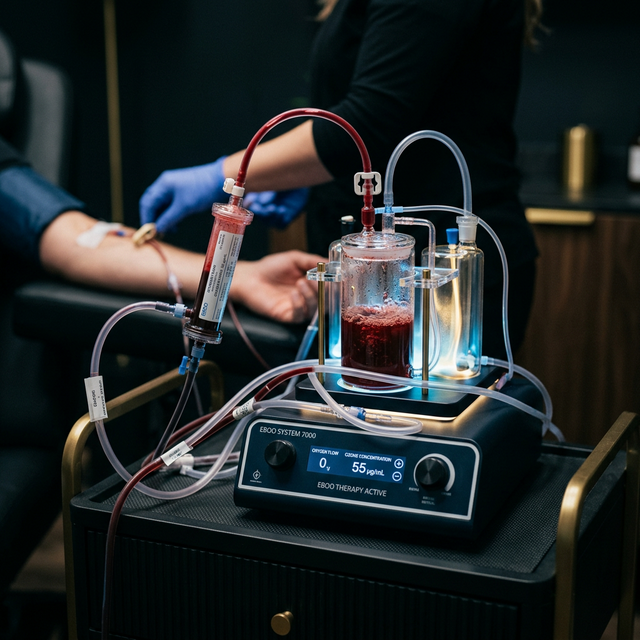
EBOO stands for extracorporeal blood oxygenation and ozonation. Blood is drawn from one arm, passed through a closed circuit outside the body, filtered through a dialysis-grade hollow-fibre membrane, exposed to a controlled mix of medical oxygen and ozone, and returned through the other arm. A session takes 60 to 90 minutes and processes roughly two litres of blood, which is why practitioners describe it as a whole-system procedure rather than a localised one. If you want the full mechanism, start with What Is EBOO Therapy?.
The reason the mechanism matters for candidacy is simple. EBOO acts on two things: circulating inflammatory load, which the filter physically removes, and oxidative balance, which the ozone stage is proposed to shift by activating the body's own antioxidant enzyme systems. So the people who are most likely to notice a difference are the people whose symptoms are being driven by those two things. If your fatigue is caused by an underactive thyroid or iron deficiency, EBOO is not the tool, and a good doctor will tell you so before you spend anything.
That is also why we do not describe EBOO as a treatment for any named disease. It is a procedure that changes the internal environment. Whether that change helps you depends on what was wrong with the environment to begin with.
The Four Signals Doctors Look For
When a doctor reviews an EBOO enquiry, they are looking for a pattern across four areas. Our assessment scores the same four dimensions, so the questions below map directly onto the report you would receive.
1. Persistent fatigue despite adequate sleep
The single most common reason people enquire. The important word is "despite". If you are sleeping five hours and feel tired, the intervention is sleep. If you are consistently getting seven or more hours and still wake unrefreshed, or hit a wall every afternoon, that is the kind of fatigue that correlates with low-grade inflammation. Doctors will still want to exclude anaemia, thyroid disease, vitamin D deficiency and sleep apnoea, because those are common and treatable.
2. Brain fog and slowed recovery
Trouble concentrating, word-finding pauses, feeling mentally slow in the morning, and taking noticeably longer to recover from training, illness or stress. These are downstream signals. On their own they mean little, but together with fatigue they form the pattern that practitioners report responds well to a series of sessions. We covered what people actually report in EBOO Therapy Benefits.
3. Low-grade inflammatory patterns
Joint or muscle pain without an injury, recurring skin flares or breakouts, gut symptoms of the bloating and IBS type, and sleep that does not restore even when it is long enough. This is the symptom cluster our assessment weights most heavily, because it is the cluster most consistent with the inflammatory mediators EBOO's filtration stage targets. A doctor will often ask for an hs-CRP and ESR here.
4. A high-exposure lifestyle
City living, frequent travel, regular alcohol, ultra-processed food, shift work and sustained stress all raise oxidative load. None of these is a diagnosis. They are context. Two people with the same symptoms can have very different baselines, and the person with the heavier exposure history is, in practice, the one more likely to notice a change when that load is reduced.
If three or four of these apply to you, you are the profile most clinics see. If none apply, you may still have a role for EBOO on a preventative basis, but the conversation will be different.
Three Goals, Three Tracks
Symptoms tell a doctor whether EBOO is relevant. Your goal tells them how to use it. We separate patients into three tracks, and the protocol, cadence and expectations differ for each.
| Track | You are probably here if | What EBOO's role is | What people report |
|---|---|---|---|
| Recovery | You have chronic symptoms, low energy or a setback and want to feel better | A foundational reset: filtration removes circulating inflammatory mediators, ozonation is proposed to reactivate suppressed antioxidant pathways | A lift in energy and clarity within days; sleep, joint pain and brain fog shifting over weeks |
| Performance | You are pushing hard at work or in training and want a sharper edge | Maintenance for a system running hot: replenishing antioxidant capacity before it turns into symptoms | Sharper focus, faster training recovery and steadier daily energy, often within hours of a session |
| Longevity | You are already healthy and building a long-term protocol | A cleanup layer that other interventions (NAD+, peptides, sauna, training) act on | A "baseline shift": biomarkers such as CRP, fasting glucose and HRV trending better rather than a dramatic acute change |
The track is not a diagnosis either. It is a way of setting expectations honestly. A Recovery patient who expects the Performance experience will be disappointed at session one, and a Longevity patient who expects to feel dramatically different is measuring the wrong thing.
Who Should Not Have EBOO (Absolute and Relative Contraindications)
This is the part of the checklist that matters most, and it is the part some clinics skip. EBOO involves anticoagulating and ozonating a large volume of your blood. A small number of conditions make that dangerous, and a larger number make it something a doctor must review first.
| Condition | Why it matters | What happens instead |
|---|---|---|
| G6PD deficiency (favism) | Ozone's oxidative load can trigger acute haemolysis in people without adequate G6PD enzyme. This is an absolute contraindication. | A G6PD assay before any session. If positive, EBOO is not offered. |
| Pregnancy or trying to conceive | Standard precautions apply and there is no safety data in pregnancy. | Treatment deferred. The consultation still happens, but planning waits. |
| Anticoagulant therapy or a bleeding disorder | The extracorporeal circuit uses anticoagulation, so your medication and clotting profile must be understood. | A screening call and a clotting profile before any decision. |
| Severe anaemia (Hb below 7 g/dL) | Removing and processing blood volume is not appropriate with a critically low haemoglobin. | Treat the anaemia first, then reassess. |
| Uncontrolled hyperthyroidism | Oxidative stimulation is inappropriate until thyroid function is controlled. | Endocrine management first. |
| Myocardial infarction in the last six months | Cardiovascular stability is required for an extracorporeal procedure. | Cardiology clearance and a waiting period. |
| Active infection with fever | Sessions are deferred during acute illness. | Reschedule once recovered. |
The first three rows are the ones our assessment screens for directly, because they are the ones people are most likely to have without realising it matters. Most people do not know their G6PD status. If any of those three is flagged, the assessment routes you to a screening call rather than a standard consultation. That is not a rejection. It is the doctor doing the review before, rather than after, you have made plans.
The Tests a Responsible Clinic Requires First
Before a first session, a responsible clinic will require:
- G6PD enzyme assay. Non-negotiable. If a provider does not ask for this, that is a reason to walk away.
- Full blood count. Screens for anaemia, low platelets and white cell abnormalities.
- Liver and kidney function. Ozone requires adequate hepatic antioxidant processing, and the circuit places a small load on renal clearance.
- Clotting profile. PT/INR and aPTT, particularly if you are on any medication that affects bleeding.
- Blood pressure. Measured on the day and monitored during the session.
Some clinics also take inflammatory markers (hs-CRP, ESR), vitamin D and ferritin as a baseline so there is something objective to compare against after a series. We recommend it. It turns "do I feel better" into "did the number move", which is a far more useful question. The full pre-session process is described in What to Expect From Your First EBOO Session.
How the 3-Minute Assessment Fits In
Our EBOO assessment asks eight questions. Three score your toxic load across lifestyle, symptoms and age, with environmental load assumed at city level because we serve London and Glasgow. One captures your goal and assigns a track. Three are the safety screen for pregnancy, G6PD and anticoagulants. You see your score part-way through and a full report at the end, with a breakdown of what contributed to it.
It is explicitly not a diagnosis. What it does is make your first conversation with a doctor more useful, because you arrive with a structured summary of exactly the things they would otherwise spend the first ten minutes asking about. The doctor reviews the report with you at a free consultation, and if EBOO is not appropriate, they say so.
Realistic Expectations Before You Decide
Three things worth knowing before you go further.
First, response varies. Some people report a noticeable lift after one session; others feel transiently tired first. Practitioners generally judge response over a series of three to six sessions, not one. Second, EBOO is not approved to treat any disease in the UK or by the FDA, and the evidence base is small and mostly drawn from ozone autohemotherapy rather than EBOO specifically. We say that plainly because a clinic that does not is not being straight with you. Third, cost matters. A single session is a significant outlay, and a series more so. EBOO Therapy Cost sets out what to expect and what should be included. If you are weighing EBOO against a lower-volume alternative, EBOO vs. Ozone Therapy is the comparison to read.
The Bottom Line
You are a likely candidate for EBOO if you have a persistent pattern of fatigue, brain fog, slow recovery or low-grade inflammatory symptoms that has not resolved with the basics, a high-exposure lifestyle, and a clear goal that fits one of the three tracks. You are not a candidate, or not yet, if you have G6PD deficiency, are pregnant or trying to conceive, are on anticoagulants or have a bleeding disorder, or have one of the other conditions in the table above. Either way, the decision is made by a doctor with your blood results in front of them. The assessment gets you to that conversation faster and better prepared.
Related reading:
- What Is EBOO Therapy? A Complete Introduction
- EBOO Therapy Benefits: What the Research Actually Says
- What to Expect From Your First EBOO Session
- EBOO vs. Ozone Therapy: Which Is Right for You?
- EBOO Therapy Cost: How Much Should You Expect to Pay?
- IV Therapy Safety Guide
This article is for educational purposes only. EBOO therapy is not approved by the MHRA or FDA as a treatment for any medical condition. Always consult a GMC-registered doctor before considering any extracorporeal or ozone-based procedure.
