The most common question we hear after "is EBOO right for me" is "how quickly will I notice anything". The honest answer is that responses vary, the evidence base is small, and anyone who gives you a confident day-by-day promise is selling rather than informing. But "it varies" is not useful on its own. What is useful is a realistic timeline of what people report, when, and by protocol track, so you can judge your own response against something.
That is what this article is. It runs from the first 24 hours to week twelve and beyond, separates the three tracks we use in clinic, lists the markers worth measuring so you are not relying on memory, and describes the signs that EBOO is not working for you, because those matter as much as the signs that it is. If you have not yet gauged your baseline, the 3-minute EBOO assessment gives you a score to compare against later.
Disclaimer: This article is for educational purposes only. EBOO therapy is not approved by the MHRA or FDA as a treatment for any medical condition. Reported outcomes are drawn from practitioner experience and small studies, not large controlled trials. Your response will be individual.
First, the Evidence Caveat
Most published research on ozone therapy concerns major autohemotherapy, which ozonates 100 to 200 millilitres of blood per session, rather than EBOO, which processes around two litres through a filtered extracorporeal circuit. The studies are small, often uncontrolled, and mostly from European and Latin American centres. Proposed mechanisms, principally activation of the Nrf2 antioxidant pathway and modulation of inflammatory cytokines, are plausible and have laboratory support, but that is not the same as outcome data. We went through what the research does and does not show in EBOO Therapy Benefits.
This is why we measure. A clinic that promises outcomes is guessing. A clinic that takes a baseline, runs a series, and re-measures is giving you a way to know. Everything below should be read with that in mind: these are patterns people report, not guarantees.
The First 24 to 72 Hours
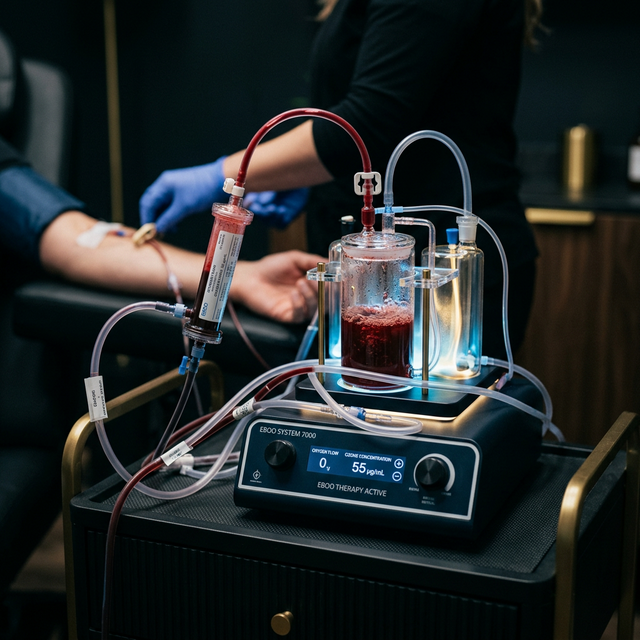
The first session is usually quieter than people expect. Sixty to ninety minutes in a reclining chair, two IV lines, a circuit that hums, and staff who check on you throughout. What happens next falls into two broad camps.
The lift. Some people, particularly those on the Performance track, report a noticeable increase in energy and mental clarity within hours and lasting a day or two. It is usually described as feeling "clearer" rather than stimulated.
The dip. Others, more often those with a heavier baseline load, feel transiently tired for 24 to 48 hours. Practitioners call this a Herxheimer-like reaction and attribute it to immune activation and the clearance of inflammatory material. It is commonly reported and generally passes on its own.
Either way, a few practical things are normal in the first three days: thirst, mild bruising or tenderness at the two access sites, and sometimes a light headache that responds to hydration. What is not normal, and warrants a call to the clinic, is fever, spreading redness or heat at an access site, chest pain, breathlessness, or symptoms that are getting worse rather than settling. The full first-session picture, including preparation, is in What to Expect From Your First EBOO Session.
Week One to Week Two
By the end of the first week most people are back to their baseline, and a subset report something better than baseline. The changes reported in this window are subtle and easy to miss unless you are tracking them: sleep that feels deeper, waking with less grogginess, a slightly shorter afternoon slump, and faster recovery from a training session or a poor night.
This is also the window in which we advise the most caution in interpretation. A single session is one data point. Placebo effects are real, and so is regression to the mean: people tend to book treatment when they feel worst, so some improvement in the following fortnight would happen regardless. Neither of those is a reason to dismiss what you notice. They are a reason to note it, keep going, and judge over the series rather than the session.
Weeks Three to Six: The Series Effect
Most clinics, ours included, work in series of three to six sessions, typically one to two weeks apart. The reasoning is mechanistic: the proposed benefit of ozonation is the upregulation of the body's own antioxidant enzyme systems, and enzyme induction builds with repeated stimulus rather than arriving in one dose. This is the window where the patterns people report become consistent enough to be worth describing by track.
| Track | What people report | What to measure | When to reassess |
|---|---|---|---|
| Recovery | Joint pain and brain fog shifting; sleep quality improving; "the tired that sleep doesn't fix" lifting; fewer bad days per week | Daily energy rating out of 10; hs-CRP and ESR at baseline and after the series; a symptom checklist repeated weekly | After session three or four; if nothing has moved by then, discuss with your doctor before continuing |
| Performance | Steadier daily energy rather than peaks and crashes; faster recovery between hard sessions; sharper focus in long working days | Training recovery metrics (HRV, resting heart rate, session RPE); focus rating; sleep score if you use a wearable | After session three; the Performance response tends to show earlier and is easy to see in wearable data |
| Longevity | Little acute change, which is expected; a sense of "baseline shift" that people struggle to describe but notice in retrospect | hs-CRP, fasting glucose, HbA1c, lipid profile, HRV trend over months rather than weeks | After the full series and a repeat blood panel; this track is judged on numbers, not feelings |
Two points about this table. First, the "what to measure" column is the most important one. Decide before you start what you will track, and track it. Second, the reassessment points are real. A series is a hypothesis test, and part of the protocol is being willing to stop.
Weeks Six to Twelve and Beyond
After a series, the question becomes cadence. Some people stop entirely and return only if symptoms drift back. Others move to a maintenance schedule of one session every four to eight weeks. Longevity-track patients most often settle into the latter and treat EBOO as the base layer that other interventions act on: NAD+ infusions, sauna, structured training, sleep work.
This is also the window in which biomarker trends become meaningful. Single blood tests fluctuate. Three tests over three months tell you something. hs-CRP trending down, fasting glucose steadier, HRV trending up: these are the outcomes Longevity patients describe when they say it "worked", and they are the ones we look for at review. If none of them has moved by week twelve, that is information too.
What Results Depend On
Five things account for most of the variation in what people report.
- Baseline load. People with a heavier inflammatory and oxidative load tend to notice more, because there is more to change. The assessment gives you a score for this before you start; Toxic Load: Symptoms, Causes and How to Measure It explains what sits behind the number.
- Lifestyle inputs during the series. Alcohol, short sleep and ultra-processed food add load faster than any procedure removes it. The people who report the clearest results are the ones who tighten these up for the duration.
- Adherence to the series. Three sessions three months apart is not a series. The mechanism depends on repeated stimulus.
- Co-existing conditions. Thyroid disease, iron deficiency, sleep apnoea and depression all produce the same symptom picture and are not addressed by EBOO. If one of these is driving your symptoms, EBOO will disappoint, which is why a doctor screens for them first.
- Ozone dose and protocol. Concentration, gas volume and circuit time vary between clinics and are adjusted to the individual. A clinic that runs one fixed protocol for everyone is not doing this properly.
Signs It Is Not Working for You
This section is short because the rule is simple. If by session three or four the marker you chose to track has not moved, or has moved the wrong way, that is the point to stop and review with your doctor rather than extend the series in hope. Persistent post-session fatigue that is not improving, symptoms that are worsening, or new symptoms that were not there before are also reasons to pause.
None of this is failure. It is the protocol doing what it is designed to do: telling you, and your doctor, whether this intervention is the right one for you. Plenty of consultations after a series end with "let's look at something else", and that is a good outcome, because it means you are not spending money on something that is not helping. EBOO Therapy Cost is worth reading before you commit to a series for exactly that reason.
Safety Reminders That Do Not Change Over Time
Results timelines do not alter the safety rules. A G6PD enzyme assay is required before the first session, without exception, because G6PD deficiency turns ozone exposure into a haemolysis risk. EBOO is deferred in pregnancy and for anyone trying to conceive. Anticoagulant therapy and bleeding disorders require a screening call and a clotting profile. Severe anaemia, uncontrolled hyperthyroidism and a heart attack within the last six months are contraindications until resolved or cleared. Am I a Candidate for EBOO? covers all of these in detail.
The Bottom Line
Expect the first 72 hours to bring either a lift or a dip, both of which are commonly reported. Expect weeks one and two to be subtle and hard to interpret. Expect weeks three to six, across a series, to be where consistent patterns appear, and judge them by track: symptoms for Recovery, wearable and recovery metrics for Performance, blood markers for Longevity. Expect week twelve to be about trends rather than events. Decide what you will measure before session one, and be willing to stop if it does not move. That is how you find out whether EBOO works for you, as opposed to whether it works in general.
Related reading:
- What to Expect From Your First EBOO Session
- EBOO Therapy Benefits: What the Research Actually Says
- Am I a Candidate for EBOO Therapy? A Doctor's Checklist
- Toxic Load: Symptoms, Causes and How to Measure It
- EBOO Therapy Cost: How Much Should You Expect to Pay?
This article is for educational purposes only. EBOO therapy is not approved by the MHRA or FDA as a treatment for any medical condition. Always consult a GMC-registered doctor before starting, continuing or stopping any treatment.